
www.technology4environment.com
18
'26
Written on Modified on
Utility-Scale Solar String Inverter with Modular Virtual Central Station
Siemens WATTBLOC 500 silicon carbide inverter builds 1 to 5 MWac solar power blocks with redundancy and easier servicing.
www.siemens.com
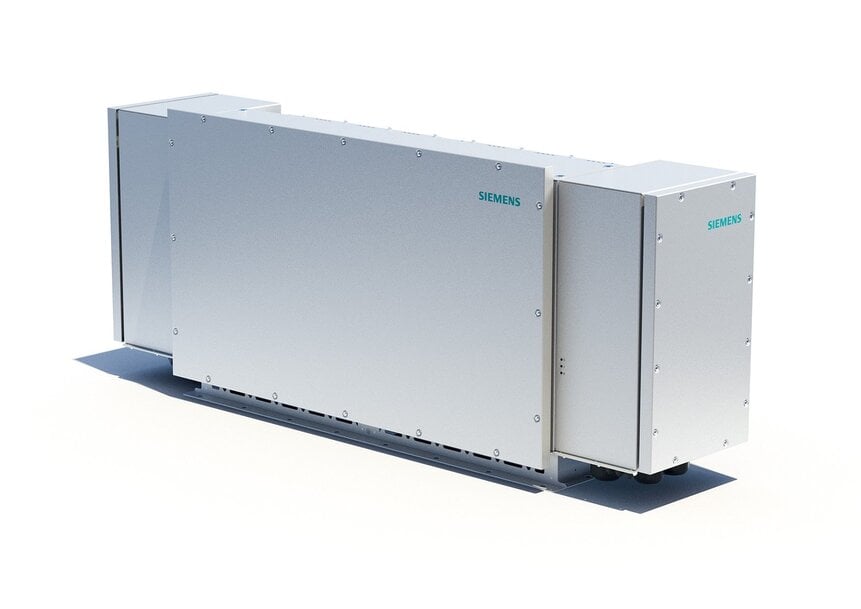
Utility-scale photovoltaic plants depend on power conversion equipment that must deliver high efficiency, grid compliance and high availability over decades of operation. Siemens has introduced WATTBLOC, a utility-scale solar platform assembled in the USA that combines the WATTBLOC 500 string inverter with a modular WATTBLOC Virtual Central Station architecture, aimed at utilities, developers, EPC contractors and asset owners.
Central Versus String Inverters in Utility-Scale Solar
Large solar plants have traditionally used central inverters, in which a single high-power unit converts the DC output of many strings into AC power. This approach concentrates conversion in one place, so a fault or maintenance outage can take a large share of plant capacity offline. String inverters distribute conversion across many smaller units, improving redundancy but traditionally requiring more integration work at plant level. The WATTBLOC platform aims to combine the advantages of both approaches.
How the WATTBLOC 500 String Inverter Works
The WATTBLOC 500 is a single maximum power point tracking (MPPT) string inverter designed for utility-scale use. It uses silicon carbide power semiconductors, active cooling and a single-stage topology. Silicon carbide devices switch faster and with lower losses than conventional silicon components, while a single-stage design avoids an additional DC-DC conversion step. Together these features enable a maximum efficiency of up to 99.2 percent.
Technical Specifications
The inverter supports AC voltage configurations from 370 V to 800 V, with power ratings from 227 kVA to 500 kVA depending on the selected voltage. It is NEMA 4X rated for outdoor installation and compliant with IEEE 2800, the standard governing interconnection of inverter-based resources to transmission systems. The unit can be deployed stand-alone or as part of a Virtual Central Station.
Virtual Central Station Architecture
The Virtual Central Station combines multiple WATTBLOC 500 modules with AC switchgear and medium-voltage transformation to form repeatable power blocks scalable from 1 MW up to 5 MWac. Because conversion and controls are distributed across independent modules, individual units can be isolated and serviced while the remaining capacity continues to operate. This reduces downtime exposure, supports higher plant availability and allows owners to standardise on one building block across a fleet.
Dave Pisano, Head of Utility Systems and Solutions for Electrification and Automation at Siemens Smart Infrastructure USA, said: "We designed WATTBLOC around a fundamentally different idea: make the power-conversion building block smaller, independent and incredibly flexible, and then allow customers to deploy it in the configuration that makes the most sense for their site."
Availability and RE+ 2026
The WATTBLOC 500 and Virtual Central Station will be available in 2027 and are on display at RE+ in Las Vegas, Nevada, from 16 to 19 November 2026, at Siemens booth N3150.
Additional Context:
This section details technical specifications and competitive benchmarking not included in the original product announcement.
IEEE 2800-2022 defines performance requirements for inverter-based resources connected to transmission and sub-transmission systems, including ride-through and grid support functions, and is increasingly referenced by US grid operators. NEMA 4X enclosures are rated for protection against windblown dust, rain, hose-directed water and corrosion. A peak efficiency of 99.2 percent places the WATTBLOC 500 among high-efficiency utility inverters, where leading central and string designs typically quote maximum efficiencies of around 98.5 to 99 percent. The use of silicon carbide in utility string inverters reflects a broader industry shift towards wide-bandgap semiconductors to raise efficiency and power density.
Edited by Natania Lyngdoh, Induportals editor, with AI assistance.
www.siemens.com
