
www.technology4environment.com
02
'26
Written on Modified on
Reducing Carbon Emissions in the Construction Materials Industry
Researchers at the Fraunhofer Institute for Ceramic Technologies and Systems IKTS are developing a membrane reactor that enables climate-neutral lime production while also recovering new raw materials.
www.fraunhofer.de
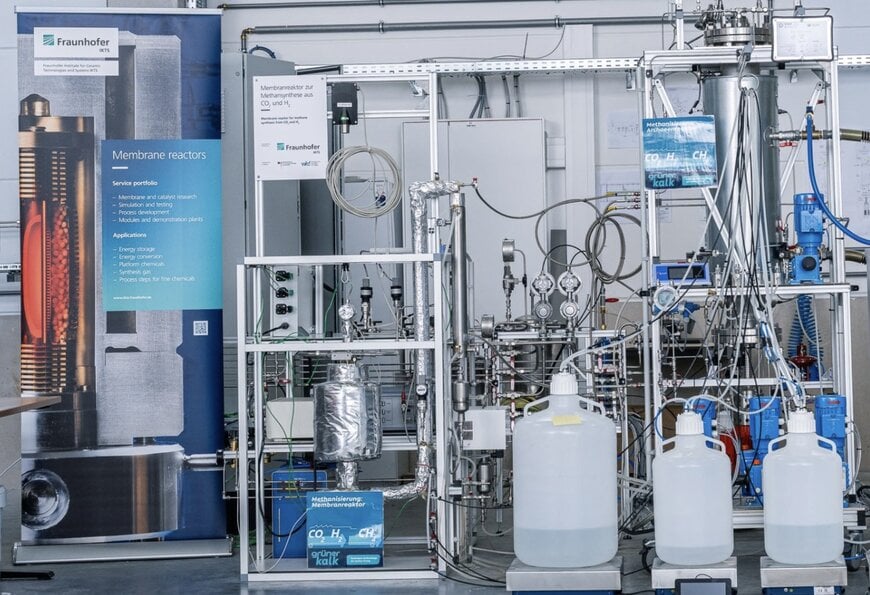
Researchers at the Fraunhofer Institute for Ceramic Technologies and Systems IKTS in Hermsdorf, Thuringia, are developing a specialized membrane reactor platform engineered to enable climate-neutral lime production. The system unifies carbon capture and utilization (CCU) workflows directly within the thermal manufacturing environment, preventing the release of process-inherent emissions while facilitating the recovery of secondary industrial raw materials.
Process Emissions and Manufacturing Constraints
The construction materials industry accounts for approximately one-quarter of global greenhouse gas emissions, representing a primary source of industrial carbon dioxide (CO2). Within this sector, traditional cement and lime production facilities require high energy consumption and generate substantial emission footprints. Exhaust gas streams from standard cement plants contain up to 33 percent CO2, while exhaust streams from specialized lime-burning operations frequently exceed 40 percent CO2.
Raw lime must undergo a high-temperature burning, or calcination, process before it can be utilized as a standardized building material. This specific chemical conversion generates the majority of the CO2 emissions produced throughout the entire manufacturing cycle. Because CO2 is chemically liberated directly from the limestone material itself during calcination, transitioning to climate-neutral manufacturing cannot be achieved solely by substituting fossil fuel gases or transitioning to standard electric furnaces.
Integrated Reactor Architecture and Carbon Capture
To address these chemical constraints, the Green Lime project team has designed a system that captures liberated CO2 during calcination instead of venting the gases into the atmosphere. The system architecture combines a custom membrane reactor with a sealed electric furnace developed by industry partner Johann Bergmann GmbH & Co. Within this sealed envelope, the CO2 released from the lime is isolated and routed directly into the reaction loop.
The integrated process utilizes a pressure-controlled dosing unit to introduce green hydrogen into the membrane reactor, sustaining a catalytic reaction that drives a methanation phase. The resulting methane product stream is continuously dried and directed to a downstream pyrolysis section, where the methane gas is thermally cracked into hydrogen and elemental carbon (carbon black). The isolated hydrogen gas is systematically recirculated back into the plant's primary reaction loop, while the elemental carbon is collected as a raw material for use within the chemical industry or as an agricultural fertilizer.
Regulatory Paradigms and Technology Transfer
The technology operates under a Carbon Capture and Utilization (CCU) framework, recovering CO2 from industrial exhaust channels to redirect it back into the manufacturing cycle. Current environmental policies primarily prioritize Carbon Capture and Storage (CCS) methods—which require the absolute removal of CO2 from the cycle for long-term geological storage—as the exclusive path to formal industrial decarbonization. Benjamin Jäger, Project Manager in the Integrated Sensor Systems group at Fraunhofer IKTS, noted that expanding regulatory awareness to include process-cycle carbon utilization technologies is essential to support long-term, climate-friendly transitions for sectors with unavoidable process emissions.
The baseline reactor concept has undergone initial verification testing conducted by project partner HySON – Institut für Angewandte Wasserstoffforschung Sonnenberg gGmbH. Following these validation tests, the research group plans to scale up the system design for active industrial deployment alongside commercial partners. The Green Lime development initiative received funding from the German Federal Ministry of Research, Technology and Space (BMFTR). Jäger emphasized that the membrane reactor platform leverages the institute's core competencies across materials development, plant design, and system integration, presenting potential deployment pathways across adjacent waste management and cement industry operations.
Additional Context
This section details technical specifications not included in the original news release.
The thermal calcination of limestone (primarily calcium carbonate, CaCO3) is an endothermic chemical decomposition reaction that requires significant thermal energy to break the ionic bonds within the crystalline lattice. The fundamental chemical reaction is expressed as follows:
CaCO3 → CaO + CO2
This reaction requires a minimum operational temperature of approximately 900°C to achieve a sufficient chemical conversion rate. Because the reaction stoichiometry dictates that every mole of processed calcium carbonate yields one mole of calcium oxide (quicklime) and one mole of gaseous carbon dioxide, nearly 44% of the total mass of pure limestone is converted directly into process gas, completely independent of any carbon emissions generated by the furnace's heating fuel.
Isolating and utilizing this process CO2 relies on integrating a catalytic Sabatier methanation loop with a high-temperature methane pyrolysis stage. Inside the membrane reactor, the captured CO2 gas stream is mixed with green hydrogen (H2) produced via water electrolysis and fed across a high-surface-area nickel or ruthenium catalyst bed at temperatures between 300°C and 400°C under moderate operating pressures. The exothermic methanation reaction proceeds as follows:
CO2 + 4H2 → CH4 + 2H2O
The membrane reactor incorporates a hydrogen-permeable palladium or ceramic membrane module. By selectively removing the generated water vapor or controlling the local partial pressure of hydrogen, the system shifts the thermodynamic equilibrium in accordance with Le Chatelier's principle, achieving high carbon dioxide conversion efficiencies.
The resulting methane (CH4) stream is passed through a condensing unit to remove residual moisture before entering the pyrolysis reactor. Inside the pyrolysis chamber, the methane is exposed to temperatures exceeding 800°C in an oxygen-free environment, frequently utilizing a liquid metal alloy bath or a fluidized carbon bed catalyst to split the hydrocarbon bonds directly:
CH4 → C + 2H2
This thermal cracking step isolates elemental carbon as a solid carbon black powder, avoiding the gaseous emissions associated with conventional combustion. The high-purity hydrogen gas produced by this cracking step is then routed back to the primary Sabatier reactor inlet, minimizing external hydrogen consumption during continuous operations.
Edited by Romila DSilva, Induportals Editor, with AI assistance.
www.fraunhofer.de
