
www.technology4environment.com
23
'26
Written on Modified on
Industrial waste treatment capacity expansion in Western France
SUEZ expands hazardous and non-hazardous waste operations at the Chenillé-Champteussé SEDA facility, securing regional treatment infrastructure and energy generation.
www.suez.com
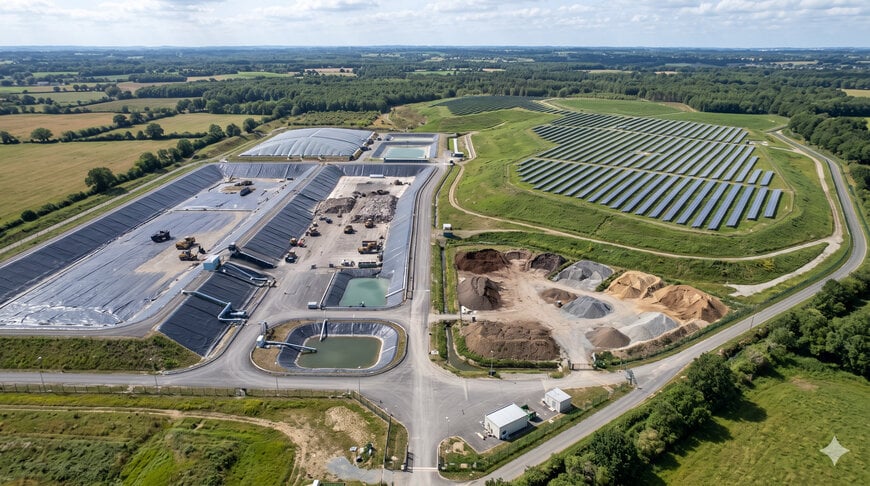
AI Generated Image
Industrial manufacturing, construction projects, and municipal operations generate substantial volumes of residual waste requiring certified containment and specialized treatment under environmental protection frameworks. Environmental services provider SUEZ has secured administrative authorization to extend and expand operations at its SEDA eco-park in Chenillé-Champteussé (Maine-et-Loire), ensuring long-term industrial waste treatment capacity across Western France.
Securing Regional Industrial Waste Treatment Capacity
Managing industrial waste streams requires specialized infrastructure that prevents soil, groundwater, and atmospheric contamination while meeting strict statutory storage guidelines. The Chenillé-Champteussé site has operated under regulated facility status within French environmental protection frameworks since 1978. Under a prefectural order approved on 25 March 2026, regulatory permission extends non-hazardous disposal operations for 16 years and hazardous waste treatment and storage activities for 27 years. Initial expansion infrastructure was commissioned on 1 September 2026 through the deployment of an engineered non-hazardous waste disposal cell.
The facility processes up to 200,000 tonnes of residual material annually. Industrial waste treatment is divided into non-hazardous waste operations handling 90,000 tonnes per year and hazardous waste containment handling 110,000 tonnes per year. This capacity serves local authorities, municipal recycling networks, wastewater treatment facilities, and private industrial operators throughout Western France.
Hazardous Waste Stabilization and Stream Integration
The hazardous waste allocation addresses regulated industrial byproducts that cannot be integrated into circular material cycles or processed through conventional incineration. The site receives civil engineering and construction debris, including asbestos, lead, heat-resistant composites, and rock wool. Industrial manufacturing and energy production residues include industrial wastewater sludge, contaminated soils, and flue gas residues, including air pollution control residues and ash from biomass boilers, solid recovered fuel facilities, and energy-from-waste plants.
Industrial waste streams require controlled stabilization to immobilize chemical contaminants and prevent leaching before placement in containment cells engineered with impermeable mineral and synthetic barrier layers. For contaminated earth, on-site physical-chemical processing allows recovery and rehabilitation of salvageable mineral fractions.
Renewable Energy Generation from Landfill Infrastructure
The facility combines waste containment with local power generation, generating 12 gigawatt-hours of renewable electricity annually, an output corresponding to the electricity consumption of roughly 8,000 residents. Power generation utilizes two parallel systems:
- A biogas recovery facility that captures anaerobic degradation gases produced within non-hazardous waste cells, routing methane to generators for conversion into electrical energy.
- A ground-mounted photovoltaic installation positioned across restored and capped landfill sections, allowing post-closure industrial surfaces to serve as renewable energy infrastructure.
Planned technical modifications and footprint additions across these energy installations are projected to double current electrical generation capacity.
National Hazardous Waste Network Expansion
Industrial continuity across manufacturing and chemical sectors depends on access to licensed hazardous waste treatment facilities. France contains approximately twelve specialized hazardous waste stabilization and underground storage sites. SUEZ operates five of these sites nationally, managing 1.6 million tonnes of annual hazardous capacity. The expansion at the SEDA eco-park follows a similar operational extension granted in September 2025 for the Villeparisis facility in Île-de-France.
The authorization secures waste treatment capacity across Western France amid tightening environmental standards, ensuring that local authorities and industries maintain certified disposal infrastructure for hazardous and residual waste while expanding regional energy generation.
Additional Context:
This section details technical specifications and competitive benchmarking not included in the original product announcement.
Hazardous waste containment and disposal in France operate under the classified installations for environmental protection (ICPE) system, specifically subject to European Council Directive 1999/31/EC on the landfill of waste and Directive 2010/75/EU on industrial emissions (IED). Hazardous waste storage requires multi-barrier construction, including bottom liners made of high-density polyethylene (HDPE) geonets and geomembranes paired with low-permeability clay subsurfaces reaching an engineered hydraulic conductivity (k) lower than or equal to 1.0 × 10^-9 meters per second.
In France, industrial waste treatment infrastructure is concentrated among major environmental management companies, predominantly SUEZ and Veolia (through its SARP Industries subsidiary). Hazardous waste landfill facilities (historically classified as Class 1 landfills) require continuous environmental monitoring systems, including leachate collection grids, groundwater observation piezometers, and fugitive methane detection. SEDA's dual-stream model—co-locating non-hazardous disposal, hazardous stabilization, and solar energy capture on capped surfaces—reflects European industrial waste asset redevelopment models designed to eliminate greenfield ground use while maintaining containment security.
Edited by Natania Lyngdoh, Induportals editor, with AI assistance.
www.suez.com
