
www.technology4environment.com
22
'26
Written on Modified on
Nuclear Waste Transmutation Radio Frequency Power Systems
General Atomics develops magnetron combining technology to lower energy consumption and equipment costs for high-power particle accelerators managing used nuclear fuel.
www.ga.com
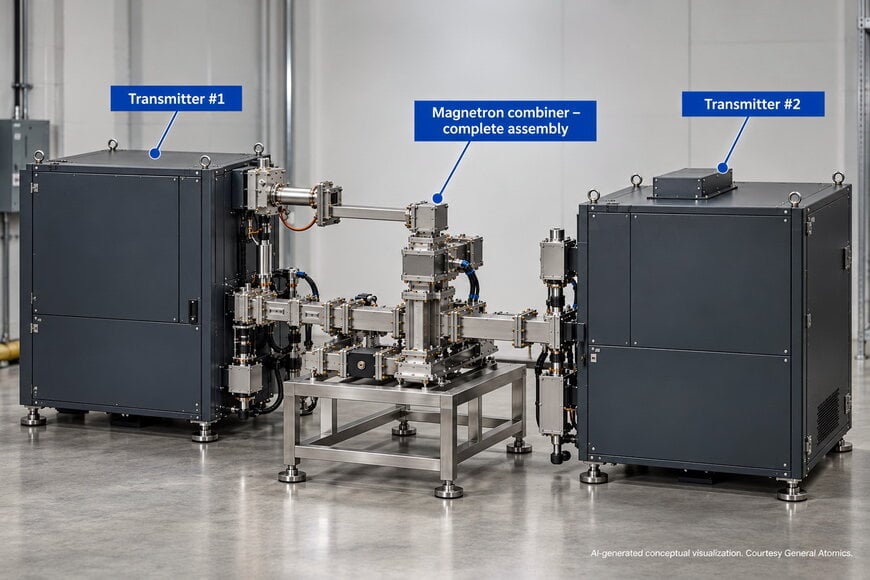
Commercial nuclear power generation faces a persistent back-end operational bottleneck in managing long-lived actinides within used fuel assemblies. In response to this industrial fuel-cycle challenge, General Atomics has assumed a lead industrial role within a multi-partner initiative to engineer an efficient, cost-effective radio frequency drive system for high-current linear accelerators targeting large-scale nuclear waste transmutation.
The Physics and Operational Bottlenecks of Spent Fuel Processing
Commercial nuclear reactors across the United States have generated more than 90,000 metric tons of used nuclear fuel, with aggregate domestic inventories expanding by roughly 2,000 metric tons annually. The overwhelming majority of this material remains sequestered in onsite cooling pools and dry cask storage installations. While commercial reprocessing infrastructure in nations such as France separates reusable fissile materials via chemical partitioning, the implementation of commercial recycling in the United States has stalled due to high facility capital expenditures and complex chemical process requirements.
Nuclear waste transmutation offers a non-chemical method to address the longest-lived radiotoxic isotopes. By directing relativistic protons or subatomic particles from high-power particle accelerators into target assemblies containing spent nuclear fuel, the system induces nuclear reactions that convert long-lived transuranic isotopes into short-lived or stable fission products. However, accelerating high-flux beams to the energy thresholds required for industrial-scale throughput demands megawatts of continuous radio frequency energy. The extreme electrical demand and low wall-plug conversion efficiency of conventional high-power microwave sources have historically rendered commercial waste-treatment accelerators economically impractical.
Magnetron Combining Architecture and Operating Principles
To lower the capital expenditure and operating electricity consumption of driver accelerators, the development team is building a high-power radio frequency source based on magnetron combining. Under the Department of Energy Advanced Research Projects Agency-Energy NEWTON program, officially designated as Nuclear Energy Waste Transmutation Optimized Now, General Atomics is collaborating with Jefferson Lab, Stellant Systems, and Oak Ridge National Laboratory.
The engineering objective centers on coupling multiple modular magnetrons into a unified, high-power radio frequency output rather than relying solely on individual large-bore klystrons or inductive output tubes. Magnetrons convert direct-current electrical input into microwave energy at high electrical efficiency and low manufacturing cost. By actively controlling the phase, frequency, and amplitude of several lower-power magnetron units, the combined system aggregates their individual outputs into a stable, high-power drive source. This architecture delivers the continuous-wave power necessary to feed the accelerating cavities of a superconducting linear accelerator, directly reducing overall facility electricity requirements and maintenance costs.
"Our team combines scientific and industrial expertise to deliver key technology that could help advance future transmutation systems toward practical, large-scale operation," stated Dr. Drew Packard, scientist for General Atomics Energy, highlighting the technical integration necessary to transition laboratory beamlines into industrial installations.
Broadening Industrial Accelerator Applications
Beyond fuel cycle optimization, reducing the capital and operational threshold of high-flux radio frequency sources expands the feasibility of high-power particle accelerators across several process industries. Stable, high-efficiency microwave power generation directly benefits the domestic production of critical medical radioisotopes, addressing supply chain vulnerabilities associated with aging research reactors.
Furthermore, industrial-scale electron beam and accelerator systems driven by efficient radio frequency power can be deployed for environmental remediation, such as the destructive breakdown of per- and polyfluoroalkyl substances in contaminated municipal and industrial wastewater streams. If the prototype validation is successful, the combined magnetron unit will be integrated with complementary accelerator components developed by the partner institutions for full-scale system demonstrations.
Additional Context
This section details technical specifications and competitive benchmarking not included in the original product announcement.
Traditional high-power linear accelerators and synchrotrons rely predominantly on klystrons, tetrodes, or modern solid-state power amplifiers to drive resonant radio frequency cavities. While klystrons can deliver continuous-wave power outputs exceeding 500 kilowatts at megawatt scales, their DC-to-RF conversion efficiency typically caps around 50 to 65 percent in standard operational regimes, and tube replacement represents a major recurring maintenance expenditure. Solid-state power amplifiers provide modularity and high operational redundancy but feature higher unit costs per watt and lower efficiency at frequencies above 1 GHz compared to vacuum electronic devices.
In contrast, industrial-grade continuous-wave magnetrons routinely demonstrate DC-to-RF conversion efficiencies reaching 70 to 85 percent, manufactured at significantly lower unit costs due to high-volume commercial production methods. The primary engineering challenge that previously prevented their deployment in accelerator systems has been phase stability: accelerators require precise phase locking within fractions of a degree across varying cavity loads. Advanced injection-locking techniques and digital low-level radio frequency feedback loops are now utilized to lock multiple magnetrons to a common master reference, matching the phase coherence of klystrons while preserving the superior electrical efficiency and lower unit cost of magnetron arrays.
Edited by Evgeny Churilov, Induportals Media - Adapted by AI.
www.ga.com
