
www.technology4environment.com
04
'26
Written on Modified on
Digital decision support optimizes aerial forest firefighting
The Fraunhofer ITWM and CAURUS Technologies are implementing a learning system for the precise control of aerial fire suppressant drops.
www.fraunhofer.de
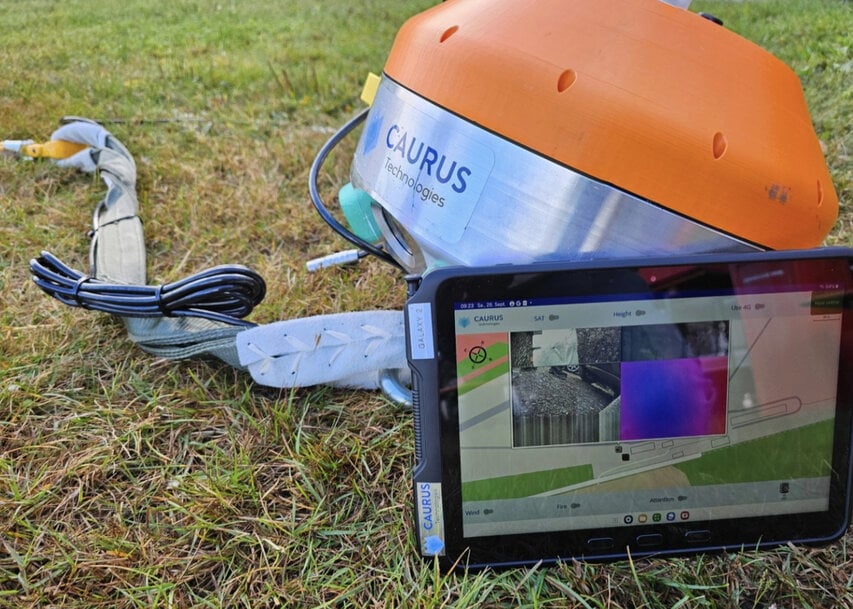
The increasing frequency and intensity of forest fires necessitate greater efficiency in firefighting operations. Historically, personnel involved in aerial firefighting have operated based largely on manual assessments, where variables such as wind currents, thermics, and vegetation structure significantly impact the effectiveness of fire suppressant drops. As part of the Forest Shield project, the Fraunhofer Institute for Industrial Mathematics ITWM and CAURUS Technologies GmbH are developing a data-driven assistance system that integrates real-time data with physical simulations. The project is funded by the Federal Ministry for Research, Technology and Space (BMFTR) as part of the FFFLab innovation community.
Technical coupling of sensor technology and simulation
The system integrates the mobile sensor platform from CAURUS Technologies with the MESHFREE simulation software developed by Fraunhofer ITWM. The sensor platform, mounted on helicopter fire buckets, captures georeferenced real-time data of the fire situation using high-resolution optical and infrared cameras as well as position sensors. These data serve as the basis for digital twins of the deployment site.
The MESHFREE simulation software calculates physically accurate models of water droplet trajectory, taking into account climatic influences and forest structure. Based on this, machine learning surrogate models are trained to enable the immediate prediction and evaluation of drop events. By feeding real-world operational data back into the simulation system, a continuously learning cloud-edge system is created that incrementally increases the precision of the predictive models.
Implementation and use cases
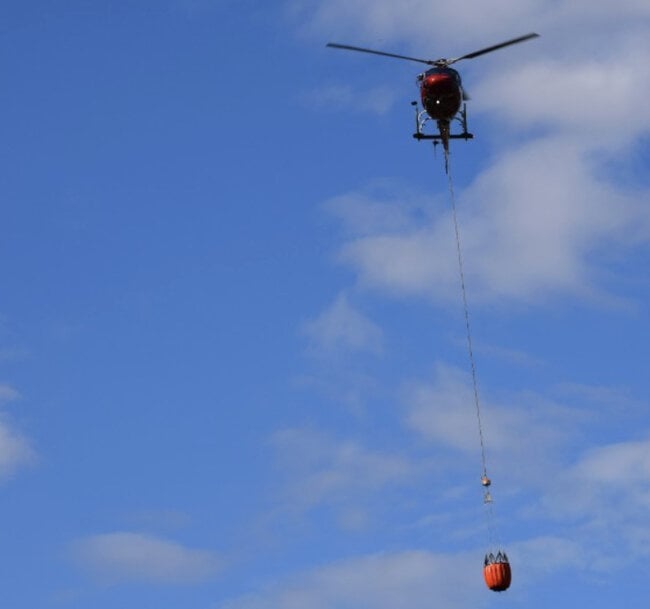
The technical solution assists incident command in determining the optimal timing and altitude for suppressant drops. This results in reduced water consumption and increased efficiency of the aircraft involved. The system was presented as a demonstrator at the INTERSCHUTZ 2026 trade fair in Hanover in June 2026. By the end of the project in July 2027, the system is scheduled for evaluation through operational test flights in cooperation with the fire department. Future extensions of the system focus on predicting fire spread and localizing personnel or vehicles within the operating area.
Edited by Maria Brueva, Induportals editor – adapted by AI.
www.fraunhofer.com
