
www.technology4environment.com
11
'26
Written on Modified on
Fraunhofer IKTS Advances High-Temperature Electrolysis for Efficient Hydrogen Production
Award-winning electrolysis stack delivers exceptional efficiency, fuel-cell versatility and scalable manufacturing for industrial hydrogen and syngas production.
www.fraunhofer.de
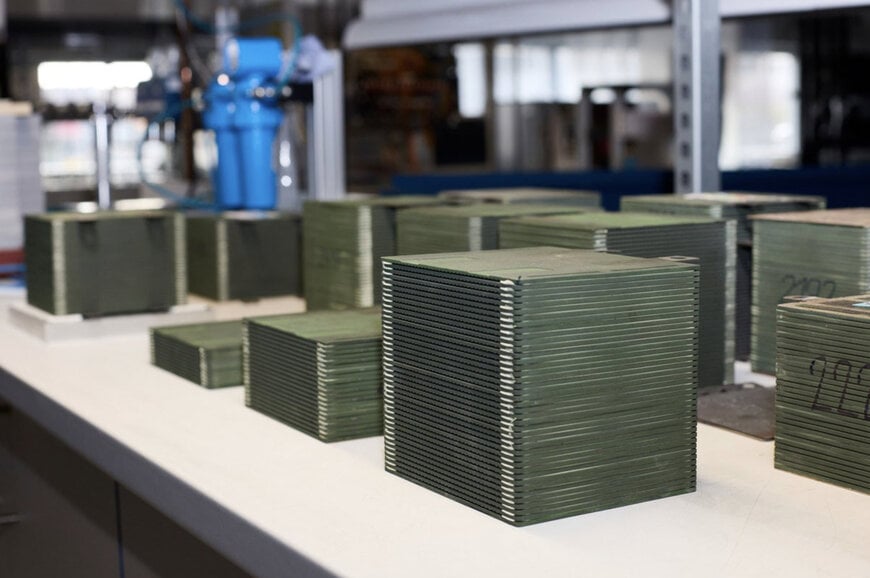
© Fraunhofer / Piotr Banczerowski: The Fraunhofer IKTS stack functions reliably within an extended temperature range of 750°C to 850°C.
The Fraunhofer Institute for Ceramic Technologies and Systems IKTS, in collaboration with its industrial partner thyssenkrupp nucera, has completed the technical development of a high-temperature electrolysis platform designed to scale green hydrogen manufacturing. This joint initiative integrates advanced materials science with automated manufacturing architectures to address scalability, energy efficiency, and cost bottlenecks across the global digital supply chain. The primary goal of this collaboration is to transition solid oxide cell technology from laboratory parameters into a partially automated pilot production framework capable of scaling to gigawatt levels.
System Architecture and Dual-Mode Operation Topologies
The technical solution functions by incorporating a high-temperature electrolysis stack that operates across an extended thermal range of 750 degrees Celsius to 850 degrees Celsius. Unlike conventional standalone architectures that require separate physical systems for distinct chemical processes, this design utilizes a reversible solid oxide cell topology. This configuration permits a single stack to function in electrolysis mode to split water vapor and carbon dioxide, or seamlessly transition into fuel cell mode to generate electricity from diverse inputs.
The mechanical configuration relies on re-engineered components optimized for high-volume serial production. The underlying infrastructure replaces custom-machined parts with metallic bipolar plates configured for fabrication within a single pressing operation. To ensure long-term process stability across state transitions, the researchers introduced advanced microstructures and protective coatings that balance thermal expansion and sintering behavior. This technical mechanism lowers overall electrical resistance, maintains a practically thermoneutral operation, and minimizes internal temperature gradients that cause component degradation.
Operational Flexibility and Regulatory Use Cases
The modular hardware addresses distinct fuel processing requirements across multiple industrial application sectors. In electrolysis mode, the platform utilizes external industrial waste heat as a direct energy source to drive the electrochemical reaction, which lowers expensive electricity consumption and enhances overall thermodynamic efficiency. In fuel cell mode, the system accepts a broad fuel portfolio including natural gas, biogas, methanol, ethanol, and green ammonia to generate electricity directly on the factory floor.
International engineering deployment and scale-up are supported by a dedicated validation infrastructure:
The Fraunhofer Institute for Ceramic Technologies and Systems IKTS, in collaboration with its industrial partner thyssenkrupp nucera, has completed the technical development of a high-temperature electrolysis platform designed to scale green hydrogen manufacturing. This joint initiative integrates advanced materials science with automated manufacturing architectures to address scalability, energy efficiency, and cost bottlenecks across the global digital supply chain. The primary goal of this collaboration is to transition solid oxide cell technology from laboratory parameters into a partially automated pilot production framework capable of scaling to gigawatt levels.
System Architecture and Dual-Mode Operation Topologies
The technical solution functions by incorporating a high-temperature electrolysis stack that operates across an extended thermal range of 750 degrees Celsius to 850 degrees Celsius. Unlike conventional standalone architectures that require separate physical systems for distinct chemical processes, this design utilizes a reversible solid oxide cell topology. This configuration permits a single stack to function in electrolysis mode to split water vapor and carbon dioxide, or seamlessly transition into fuel cell mode to generate electricity from diverse inputs.
The mechanical configuration relies on re-engineered components optimized for high-volume serial production. The underlying infrastructure replaces custom-machined parts with metallic bipolar plates configured for fabrication within a single pressing operation. To ensure long-term process stability across state transitions, the researchers introduced advanced microstructures and protective coatings that balance thermal expansion and sintering behavior. This technical mechanism lowers overall electrical resistance, maintains a practically thermoneutral operation, and minimizes internal temperature gradients that cause component degradation.
Operational Flexibility and Regulatory Use Cases
The modular hardware addresses distinct fuel processing requirements across multiple industrial application sectors. In electrolysis mode, the platform utilizes external industrial waste heat as a direct energy source to drive the electrochemical reaction, which lowers expensive electricity consumption and enhances overall thermodynamic efficiency. In fuel cell mode, the system accepts a broad fuel portfolio including natural gas, biogas, methanol, ethanol, and green ammonia to generate electricity directly on the factory floor.
International engineering deployment and scale-up are supported by a dedicated validation infrastructure:
- Production Validation: The research team established a partially automated pilot line at its Arnstadt location within a 14-month engineering cycle to verify mass-production readiness.
- Chemical Synthesis: Within the specified temperature envelope, the system converts water vapor and carbon dioxide into synthesis gas, providing raw inputs for downstream chemical manufacturing.
- Awards and Recognition: The foundational material innovation and system design earned the development team the Joseph von Fraunhofer Prize for 2026.
By substituting separate manufacturing lines with a unified, dual-mode production framework, the platform provides supply chain partners with a highly compact energy asset that reduces structural manufacturing costs and secures international infrastructure scalability.
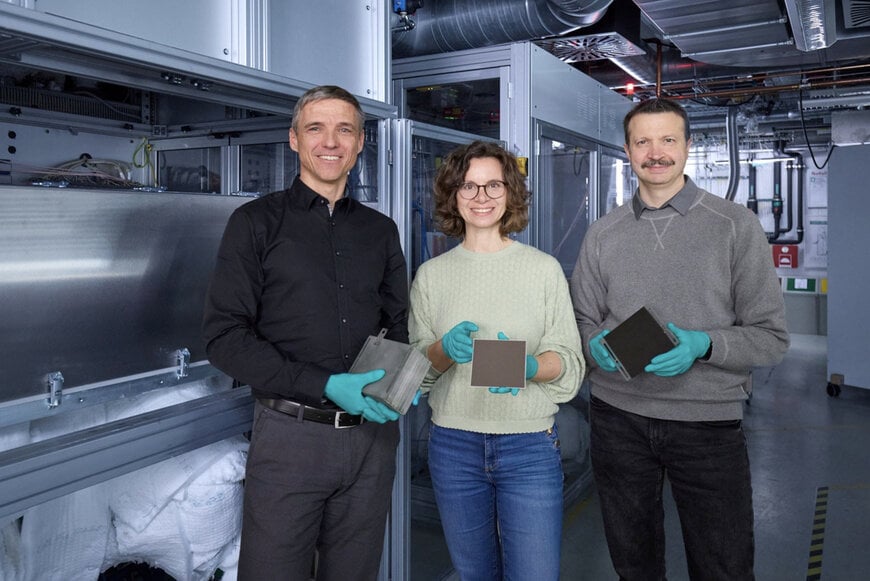
© Fraunhofer / Piotr Banczerowski: The winners of the 2026 Joseph von Fraunhofer Prize: Stefan Megel, Sindy Mosch and Mihails Kusnezoff (from left) from Fraunhofer IKTS
Additional Context:
This section details technical specifications and competitive benchmarking not included in the original product announcement
The industrial scaling of high-temperature electrolysis represents a distinct operational alternative to low-temperature Alkaline Electrolysis and Proton Exchange Membrane systems. Traditional low-temperature technologies exhibit high commercial maturity but operate at lower thermodynamic efficiencies because they cannot utilize external industrial waste heat, forcing a complete reliance on electrical energy inputs to drive the water-splitting reaction. By operating at elevated thermal parameters, the high-temperature solid oxide framework minimizes the total Gibbs free energy demand of the process, reducing the electrical consumption required per kilogram of hydrogen produced.
In comparison to conventional Proton Exchange Membrane configurations that depend heavily on expensive noble metal catalysts such as platinum and iridium, the solid oxide architecture utilizes ceramic and nickel-based materials. This material design avoids supply chain single-point failures and prevents severe exposure to raw material price volatility. Furthermore, while standard low-temperature electrolyzers are strictly limited to pure water splitting, the reversible high-temperature stack supports co-electrolysis of water and carbon dioxide to yield synthesis gas. This capability enables direct integration with existing manufacturing execution systems and industrial networks to establish closed-loop carbon capture and utilization pipelines.
Edited by Natania Lyngdoh, Induportals editor, assisted by AI.
www.fraunhofer.com
© Fraunhofer / Piotr Banczerowski: The winners of the 2026 Joseph von Fraunhofer Prize: Stefan Megel, Sindy Mosch and Mihails Kusnezoff (from left) from Fraunhofer IKTS
Additional Context:
This section details technical specifications and competitive benchmarking not included in the original product announcement
The industrial scaling of high-temperature electrolysis represents a distinct operational alternative to low-temperature Alkaline Electrolysis and Proton Exchange Membrane systems. Traditional low-temperature technologies exhibit high commercial maturity but operate at lower thermodynamic efficiencies because they cannot utilize external industrial waste heat, forcing a complete reliance on electrical energy inputs to drive the water-splitting reaction. By operating at elevated thermal parameters, the high-temperature solid oxide framework minimizes the total Gibbs free energy demand of the process, reducing the electrical consumption required per kilogram of hydrogen produced.
In comparison to conventional Proton Exchange Membrane configurations that depend heavily on expensive noble metal catalysts such as platinum and iridium, the solid oxide architecture utilizes ceramic and nickel-based materials. This material design avoids supply chain single-point failures and prevents severe exposure to raw material price volatility. Furthermore, while standard low-temperature electrolyzers are strictly limited to pure water splitting, the reversible high-temperature stack supports co-electrolysis of water and carbon dioxide to yield synthesis gas. This capability enables direct integration with existing manufacturing execution systems and industrial networks to establish closed-loop carbon capture and utilization pipelines.
Edited by Natania Lyngdoh, Induportals editor, assisted by AI.
www.fraunhofer.com
