
www.technology4environment.com
12
'26
Written on Modified on
Daimler Truck, MB Energy, Kawasaki Develop Hydrogen Supply Chain
The cooperation focuses on developing a liquefied hydrogen supply chain to Europe via Hamburg for transport and industrial energy applications.
www.daimlertruck.com
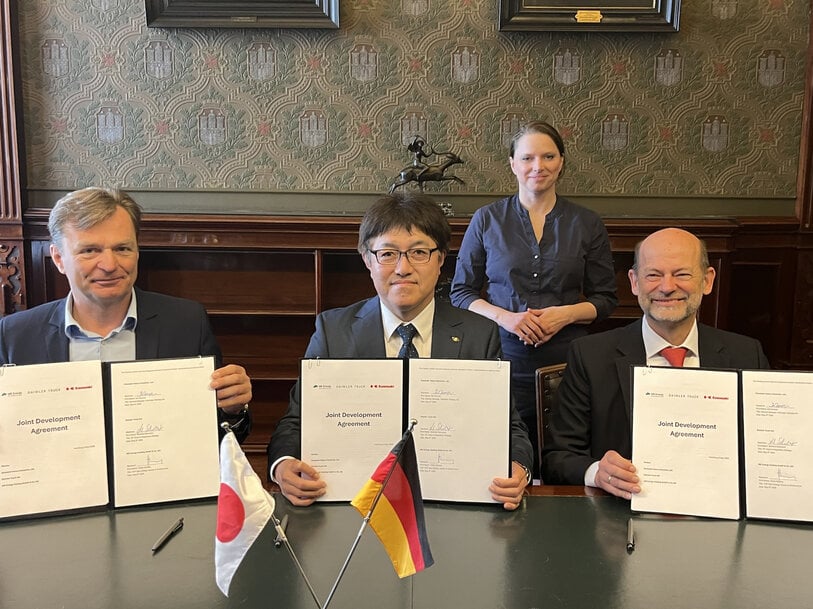
Daimler Truck, MB Energy and Kawasaki Heavy Industries have signed a Joint Development Agreement to study the implementation of a liquefied hydrogen supply chain connecting international hydrogen production regions with the Port of Hamburg. The project targets commercial operation in the early 2030s and supports hydrogen deployment in heavy-duty transport and industrial energy applications.
Hydrogen Infrastructure for Heavy Transport
The cooperation addresses a key limitation in hydrogen-powered mobility: the absence of large-scale liquefied hydrogen (LH2) import and distribution infrastructure in Europe. Long-haul fuel cell trucks require high energy density and rapid refueling capability, making liquefied hydrogen more suitable than compressed gaseous storage for certain transport operations.
The project combines maritime hydrogen transport, terminal infrastructure, storage systems and downstream distribution. Hamburg was selected due to its existing logistics infrastructure and its role as a major European port for energy imports and industrial supply chains.
The cooperation also aligns with broader efforts to expand digital infrastructure and alternative fuel systems supporting transport decarbonization.
Division of Technical Responsibilities
Daimler Truck will contribute vehicle integration requirements and hydrogen-powered heavy-duty vehicle deployment expertise. The company plans to introduce liquid hydrogen fuel cell trucks into customer operations from 2026, with larger-scale production expected in the early 2030s.
MB Energy will focus on fuel sourcing, trading, logistics and downstream distribution infrastructure. Its role includes evaluating the conversion of selected service station sites into LH2 refueling locations positioned along long-haul freight corridors.
Kawasaki Heavy Industries will provide engineering expertise for the liquefied hydrogen transport chain, including hydrogen liquefaction systems, cryogenic storage tanks and LH2 carrier ships. Liquefied hydrogen must typically be stored at temperatures near -253°C, requiring specialized insulated storage and transfer systems to minimize boil-off losses during transport and handling.
Supply Chain Development and Deployment
The partners will conduct technical and economic feasibility studies covering import terminal design, maritime transport routes, storage integration and hydrogen distribution within Germany and neighboring European markets.
The proposed system is intended to function as an end-to-end supply chain connecting hydrogen-producing regions with industrial users and zero-emission transport fleets. Studies will also evaluate scalability, infrastructure interoperability and operational reliability for long-distance freight applications.
Initial deployment is expected to focus on logistics hubs and freight corridors where hydrogen-powered trucks can operate with centralized refueling infrastructure.
Industrial Applications and Expected Impact
Target applications include heavy-duty road transport, industrial energy supply and sectors requiring high-capacity zero-emission fuel solutions. The use of liquefied hydrogen could support longer vehicle range and reduced refueling frequency compared with compressed hydrogen systems.
The cooperation aims to establish a technically integrated hydrogen import corridor capable of supporting future industrial automation, freight logistics and transport decarbonization strategies across Europe.
Edited by Natania Lyngdoh, Induportals Editor, with AI assistance.
www.daimlertruck.com
