
www.technology4environment.com
20
'26
Written on Modified on
KBR advances liquid hydrogen terminal engineering with EcoLog
FEED scope defines cryogenic infrastructure, storage systems, and integrated hydrogen-CO₂ handling for large-scale energy logistics in Europe.
www.kbr.com
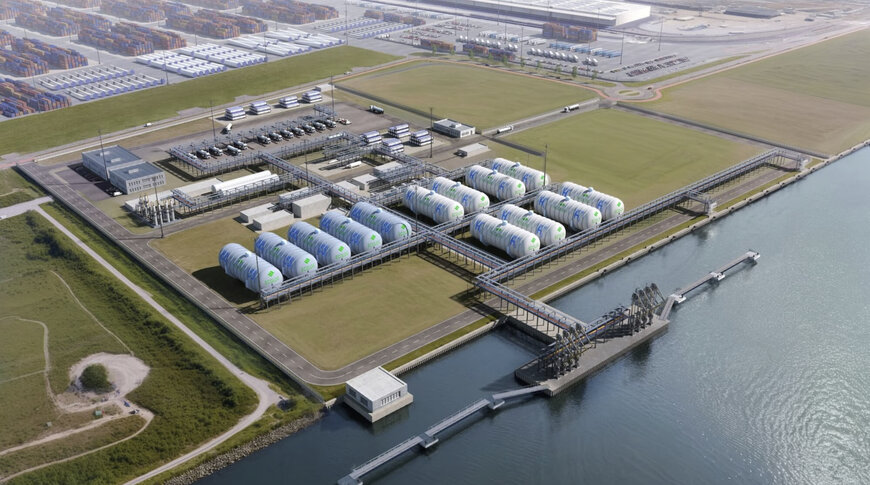
For hydrogen infrastructure, carbon management, and industrial decarbonization sectors, KBR has been selected to deliver the Front-End Engineering Design (FEED) for a commercial-scale terminal designed to import liquid hydrogen (LH₂) and export liquid CO₂ (LCO₂). The project introduces integrated cryogenic handling, multi-modal transport connectivity, and energy recovery systems to support high-throughput, low-carbon supply chains.
Infrastructure for hydrogen and CO₂ value chains
The terminal, under development in the Port of Amsterdam, is designed to function as a central logistics hub connecting hydrogen production regions with industrial demand across Northern Europe. Target sectors include steel manufacturing, heavy-duty transport, maritime operations, and data center energy systems.
Once operational, with commissioning targeted for the end of 2030, the facility is planned to handle both gaseous and liquid hydrogen alongside CO₂ streams intended for reuse or offshore storage. Initial capacity is defined at 200,000 tonnes per year of LH₂ and 1.8 million tonnes of LCO₂, with expansion potential up to 600,000 tonnes and 4.25 million tonnes respectively.
Engineering scope focused on cryogenic performance and safety
Under the FEED contract, KBR will establish the technical foundation for the terminal, including storage configurations, process design, operating conditions, and safety frameworks required for large-scale LH₂ handling.
Liquid hydrogen storage and transfer require temperatures near −253°C, imposing strict requirements on materials, insulation, and boil-off gas management. The FEED phase will therefore define key parameters for cryogenic containment systems, transfer interfaces, and integration with transport infrastructure, ensuring operational stability and safety at scale.
Multi-modal transport integration
The terminal design incorporates multiple transport interfaces to ensure flexibility in distribution and supply. These include dual hydrogen pipeline connections for high- and low-pressure applications, a dedicated CO₂ pipeline, truck loading systems, rail access, and a barge jetty for inland waterways.
In parallel, the infrastructure is being aligned with a new generation of liquid hydrogen carriers, enabling direct maritime transport of LH₂. This integrated approach supports continuous flow between production sites, storage facilities, and end users.
Energy recovery through cryogenic integration
A notable engineering feature of the project is the planned recovery of cold energy released during LH₂ regasification. This thermal energy can be reused to liquefy CO₂, reducing the overall energy demand of the terminal.
Such integration improves system efficiency by linking hydrogen and carbon management processes within a single infrastructure. It also reduces the need for additional energy input in CO₂ liquefaction, which is typically energy-intensive.
Defining benchmarks for large-scale LH₂ infrastructure
The project represents one of the first attempts to standardize engineering practices for commercial-scale liquid hydrogen import terminals. By addressing challenges related to cryogenic storage, transport integration, and safety, the FEED phase is expected to contribute to the development of global design benchmarks.
In parallel with its work on hydrogen systems, KBR continues to expand its involvement in CO₂ management and low-carbon infrastructure, reflecting broader industry efforts to build scalable and interoperable energy systems.
Edited by Industrial Journalist Natania Lyngdoh — Adapted by AI.
www.kbr.com
