
www.technology4environment.com
04
'26
Written on Modified on
Fraunhofer FKIE Develops Drones & Robots for Radiological Localization
Researchers at Fraunhofer FKIE are advancing unmanned aerial and ground systems to detect, localize, and recover radioactive materials using automated sensor fusion and adaptive navigation.
www.fraunhofer.de
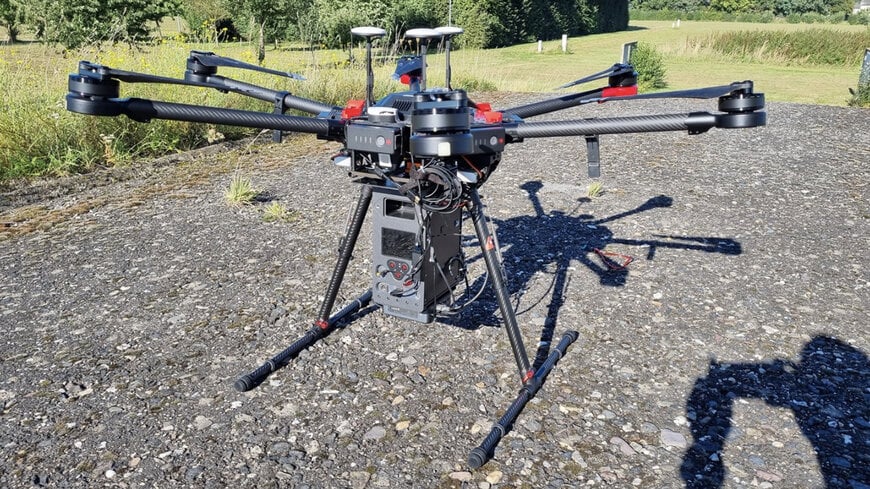
© Fraunhofer FKIE: In addition to a gamma detector, the highly automated UAS also has electro-optical and infrared cameras on board.
Civil protection, emergency response, and security operations increasingly face situations involving radioactive, chemical, or biological hazards that are not perceptible to humans and are difficult to detect using conventional remote sensing. To address these challenges, researchers at Fraunhofer Institute for Communication, Information Processing and Ergonomics FKIE are developing drone- and robot-based systems capable of rapidly and precisely localizing radioactive sources in complex environments.
Chemical, biological, radiological, nuclear, and explosive substances—summarized as CBRNE materials—pose risks both to the public and to first responders. Small radioactive sources can trigger large-scale search operations, as demonstrated by an incident in Australia in 2023 involving a cesium capsule only a few millimeters in size. Against the backdrop of increasing hybrid threats and destabilization attempts, two research departments at Fraunhofer FKIE are focusing on how unmanned aerial systems (UAS) and unmanned ground vehicles (UGV) can support response teams in such scenarios.
The performance and practical suitability of these systems have been evaluated over multiple years at large-scale field events, including the European Robotics Hackathon at the Zwentendorf nuclear power plant and the European Land Robot Trial. These test environments allow researchers to assess system reliability under realistic operating conditions and iteratively improve automation, sensing, and navigation capabilities.
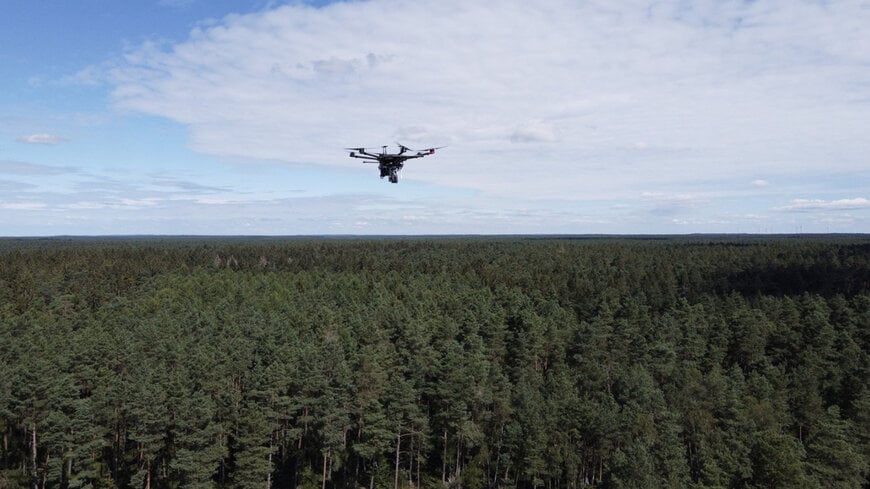
© Fraunhofer FKIE: A first technology demonstrator has already been successfully tested. It can precisely detect a radioactive source to within a few meters in only a few minutes.
Automated aerial detection of radioactive sources
Within a research project commissioned by the Bundeswehr Research Institute for Protective Technologies and CBRN Protection (WIS), the Sensor Data and Information Fusion department is developing a highly automated UAS designed to detect and localize radioactive sources. A technology demonstrator has already been validated in field trials at the WIS site in Munster, where it localized radioactive sources within a few meters in a matter of minutes.
The detection workflow is divided into an exploration phase and a targeted search phase. During exploration, the UAS follows a predefined flight pattern while continuously measuring background radiation. Once deviations are detected, the system transitions into an adaptive search mode. In this phase, stochastic algorithms estimate the probability of the source location and dynamically adjust the flight path based on accumulated and real-time sensor data.
The drone generates spatial heat maps that visualize radiation intensity across the surveyed area, complemented by probability maps indicating the most likely source location. Localization results are automatically reported once sufficient confidence is achieved.
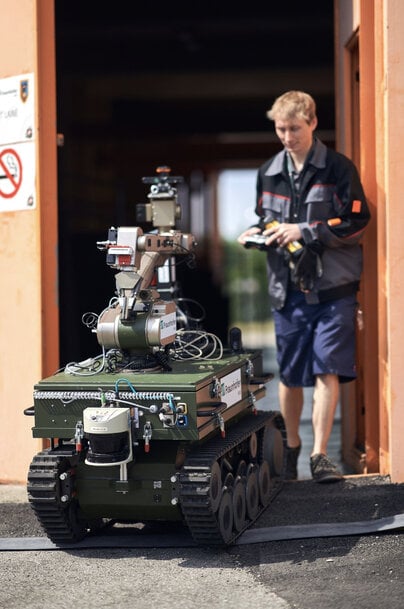
© Fraunhofer FKIE/Fabian Vogl: The experimental CBRNE robot assists in the detection and recovery of radioactive hazardous materials.
Sensor fusion and onboard processing
The UAS is equipped with a gamma radiation detector, electro-optical and infrared cameras, an inertial measurement unit, and an onboard computer for real-time data processing. An LTE communication module enables live data transmission to ground stations. Camera data is georeferenced, allowing detected objects such as buildings, vehicles, or people to be displayed in their spatial context, while the IMU provides precise 3D position and motion tracking.
This work is part of the HUGIYN project, which focuses on automated detection of gamma-emitting nuclides. Follow-up research under the SLEIPNIR project aims to increase flight speed and enable the localization of multiple or moving radioactive sources.
Ground robots for hazardous environments
In environments that are too dangerous for human access, uncrewed ground vehicles complement aerial systems. The Cognitive Mobile Systems department is researching robots equipped with CBRNE sensors, autonomous navigation strategies, and geodata processing capabilities to support detection and recovery tasks.
Radiation measurements collected by these robots during preliminary reconnaissance are compared with baseline data from Germany’s official radioactivity monitoring system¹. Using data fusion, researchers integrate both datasets into radiation heat maps to assess whether measured anomalies indicate a real threat or fall within normal background levels.
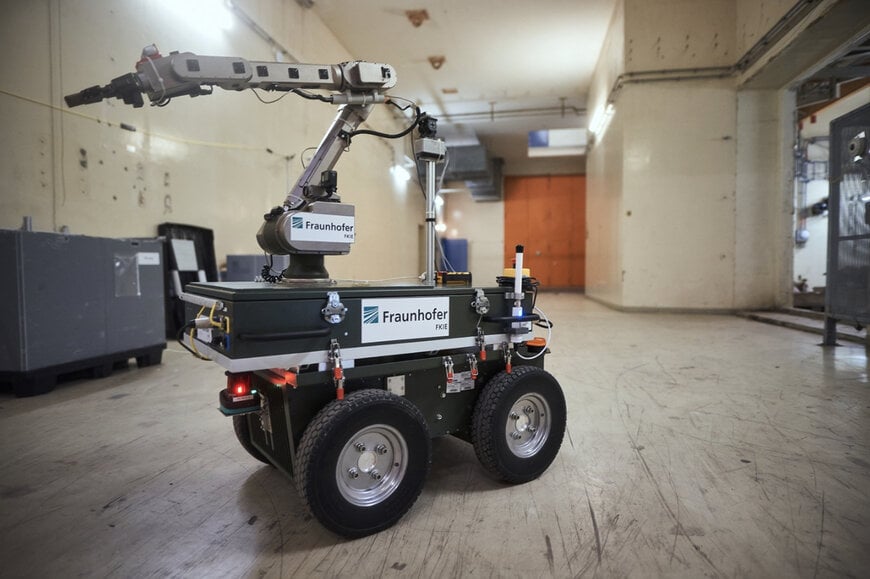
© Fraunhofer FKIE/Fabian Vogl: The innovative "Click & Grasp" system enables the gripper arm to perform complex movements.
Assisted manipulation and intuitive control
Beyond detection, Fraunhofer FKIE is developing assistive functions that enable robots to safely recover hazardous materials. A click-and-grasp system allows operators to select objects directly from live video feeds, triggering automated manipulation sequences. In testing, robots autonomously collected contaminated material, assessed radiation levels, and transferred objects into secure containers. The system also supports complex actions such as opening vehicle doors, enabling access to enclosed spaces.
Additional research focuses on advanced human–machine interaction. By generating photorealistic 3D models and virtual reality environments from sensor data, operators can inspect scenes from multiple perspectives without repositioning the robot. Wearable sensors further allow intuitive control by translating human arm movements directly to robotic manipulators, expanding usability to emergency personnel without specialized robotics training.
¹The BfS ambient gamma dose rate monitoring network includes roughly 1,700 measuring points distributed throughout Germany
www.fraunhofer.com
Civil protection, emergency response, and security operations increasingly face situations involving radioactive, chemical, or biological hazards that are not perceptible to humans and are difficult to detect using conventional remote sensing. To address these challenges, researchers at Fraunhofer Institute for Communication, Information Processing and Ergonomics FKIE are developing drone- and robot-based systems capable of rapidly and precisely localizing radioactive sources in complex environments.
Chemical, biological, radiological, nuclear, and explosive substances—summarized as CBRNE materials—pose risks both to the public and to first responders. Small radioactive sources can trigger large-scale search operations, as demonstrated by an incident in Australia in 2023 involving a cesium capsule only a few millimeters in size. Against the backdrop of increasing hybrid threats and destabilization attempts, two research departments at Fraunhofer FKIE are focusing on how unmanned aerial systems (UAS) and unmanned ground vehicles (UGV) can support response teams in such scenarios.
The performance and practical suitability of these systems have been evaluated over multiple years at large-scale field events, including the European Robotics Hackathon at the Zwentendorf nuclear power plant and the European Land Robot Trial. These test environments allow researchers to assess system reliability under realistic operating conditions and iteratively improve automation, sensing, and navigation capabilities.
© Fraunhofer FKIE: A first technology demonstrator has already been successfully tested. It can precisely detect a radioactive source to within a few meters in only a few minutes.
Automated aerial detection of radioactive sources
Within a research project commissioned by the Bundeswehr Research Institute for Protective Technologies and CBRN Protection (WIS), the Sensor Data and Information Fusion department is developing a highly automated UAS designed to detect and localize radioactive sources. A technology demonstrator has already been validated in field trials at the WIS site in Munster, where it localized radioactive sources within a few meters in a matter of minutes.
The detection workflow is divided into an exploration phase and a targeted search phase. During exploration, the UAS follows a predefined flight pattern while continuously measuring background radiation. Once deviations are detected, the system transitions into an adaptive search mode. In this phase, stochastic algorithms estimate the probability of the source location and dynamically adjust the flight path based on accumulated and real-time sensor data.
The drone generates spatial heat maps that visualize radiation intensity across the surveyed area, complemented by probability maps indicating the most likely source location. Localization results are automatically reported once sufficient confidence is achieved.
© Fraunhofer FKIE/Fabian Vogl: The experimental CBRNE robot assists in the detection and recovery of radioactive hazardous materials.
Sensor fusion and onboard processing
The UAS is equipped with a gamma radiation detector, electro-optical and infrared cameras, an inertial measurement unit, and an onboard computer for real-time data processing. An LTE communication module enables live data transmission to ground stations. Camera data is georeferenced, allowing detected objects such as buildings, vehicles, or people to be displayed in their spatial context, while the IMU provides precise 3D position and motion tracking.
This work is part of the HUGIYN project, which focuses on automated detection of gamma-emitting nuclides. Follow-up research under the SLEIPNIR project aims to increase flight speed and enable the localization of multiple or moving radioactive sources.
Ground robots for hazardous environments
In environments that are too dangerous for human access, uncrewed ground vehicles complement aerial systems. The Cognitive Mobile Systems department is researching robots equipped with CBRNE sensors, autonomous navigation strategies, and geodata processing capabilities to support detection and recovery tasks.
Radiation measurements collected by these robots during preliminary reconnaissance are compared with baseline data from Germany’s official radioactivity monitoring system¹. Using data fusion, researchers integrate both datasets into radiation heat maps to assess whether measured anomalies indicate a real threat or fall within normal background levels.
© Fraunhofer FKIE/Fabian Vogl: The innovative "Click & Grasp" system enables the gripper arm to perform complex movements.
Assisted manipulation and intuitive control
Beyond detection, Fraunhofer FKIE is developing assistive functions that enable robots to safely recover hazardous materials. A click-and-grasp system allows operators to select objects directly from live video feeds, triggering automated manipulation sequences. In testing, robots autonomously collected contaminated material, assessed radiation levels, and transferred objects into secure containers. The system also supports complex actions such as opening vehicle doors, enabling access to enclosed spaces.
Additional research focuses on advanced human–machine interaction. By generating photorealistic 3D models and virtual reality environments from sensor data, operators can inspect scenes from multiple perspectives without repositioning the robot. Wearable sensors further allow intuitive control by translating human arm movements directly to robotic manipulators, expanding usability to emergency personnel without specialized robotics training.
¹The BfS ambient gamma dose rate monitoring network includes roughly 1,700 measuring points distributed throughout Germany
www.fraunhofer.com
