
www.technology4environment.com
29
'26
Written on Modified on
Low-carbon concrete supports Queensland residential developments
Keylin adopted low-carbon concrete for two residential projects in Queensland to reduce embodied carbon while maintaining structural performance and construction quality.
www.holcim.com.au
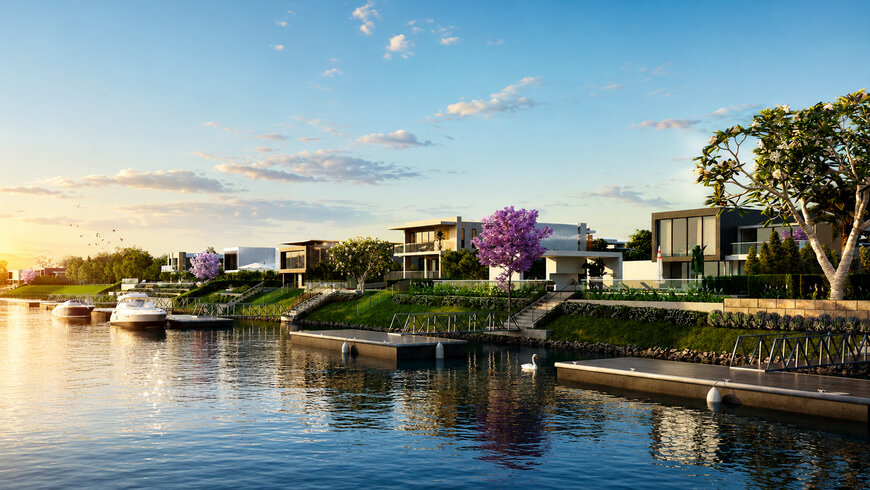
Residential developer Keylin is delivering two major projects in Queensland: Oria Spring Hill in Brisbane and Lakeside Serenity 4212 on the Gold Coast, the latter developed in partnership with Kinstone Group. Although differing in size and location, both developments were designed to combine high-quality residential construction with improved environmental performance.
A key objective was reducing the embodied carbon associated with construction materials without affecting structural integrity, durability or project schedules. Concrete was identified as an area where measurable reductions could be achieved.
Transition to low-carbon concrete during project delivery
Holcim Australia supplied both developments with ECOPact, a low-carbon ready-mix concrete designed for structural applications.
At Oria Spring Hill, the project initially commenced using a standard concrete mix. During an early-stage meeting involving Holcim, builder CoStruct and Keylin’s development team, discussions focused on the project’s sustainability goals and whether the concrete specification could better align with these objectives.
Following this review, the project transitioned to ECOPact. More than 80 percent of the concrete supplied to the development has subsequently been delivered using the lower-carbon alternative.
Low-carbon specification integrated from project outset
The experience gained during the Brisbane project influenced material selection for Lakeside Serenity 4212 in Helensvale on the Gold Coast.
The waterfront development comprises 85 apartments and four villas located within the Serenity 4212 master-planned community. Based on the results achieved at Oria Spring Hill, ECOPact was specified from the beginning of the project. Standard concrete mixes were used only where they represented the most appropriate technical solution, while ECOPact accounted for almost all concrete deliveries.
Concrete performance without changes to construction programs
One of the primary reasons for selecting ECOPact was its ability to meet structural requirements while delivering environmental benefits.
According to Holcim, the concrete provides a minimum 30 percent reduction in embodied carbon compared with conventional ordinary Portland cement concrete. The reduction is supported by Environmental Product Declarations (EPDs) registered with EPD Australasia.
Across both developments, the material has been used for footings, slabs, columns and walls without requiring modifications to construction schedules or installation methods. This allowed project teams to integrate lower-carbon concrete without disrupting established building processes.
Early collaboration simplifies sustainable construction
The projects demonstrate how early collaboration between developers, contractors and material suppliers can influence sustainability outcomes.
By addressing carbon reduction objectives during planning and specification stages rather than later in construction, project teams were able to incorporate lower-carbon materials as part of the original project strategy.
According to Dylan Viviers, Specifications Manager at Holcim Australia, the transition at Oria Spring Hill resulted from discussions between Holcim, CoStruct and Keylin regarding the material’s performance and environmental characteristics.
Results across both developments suggest that lower-carbon concrete can be incorporated into residential construction projects without compromising performance, durability or build quality, while contributing to embodied carbon reduction targets.
Edited by Sucithra Mani, Induportals editor – adapted by AI.
www.holcim.com.au
