
www.technology4environment.com
06
'26
Written on Modified on
Large-Scale Grid Battery for Frequency Stabilization
Neoen deploys 496 MWh storage system to support grid stability and renewable integration in the Île-de-France electricity network.
neoen.com
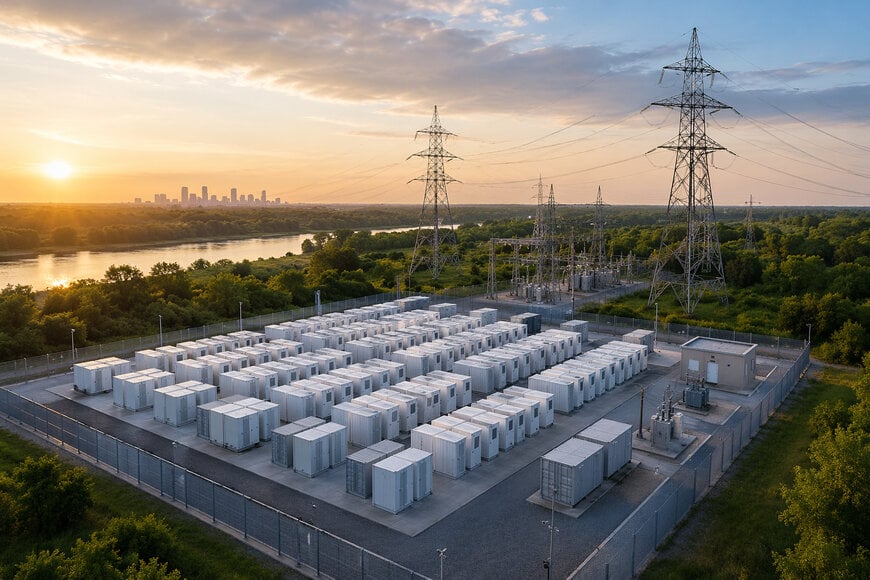
Neoen has announced the construction of a 248 MW / 496 MWh battery energy storage system in Vernou-la-Celle-sur-Seine, designed to provide grid balancing services and support renewable energy integration in the French transmission network.
High-capacity storage for transmission-level applications
The project represents the largest battery energy storage system deployed in France to date and is notable for its direct connection to a 400 kV high-voltage transmission network. Located near the Chesnoy substation, approximately 90 km southeast of Paris, the system is positioned to support the Île-de-France region, where electricity demand density and grid constraints are significant.
With a connection capacity of 200 MW, the system will deliver frequency and voltage regulation services. These ancillary services are critical for maintaining grid stability, particularly as intermittent renewable energy sources such as solar and wind increase their share in the energy mix.
System architecture and industrial integration
The battery modules will be supplied by Nidec ASI and assembled in France at a production facility in La Fouillouse, near Saint-Étienne. This localized manufacturing approach contributes to the industrialization of battery storage within the European energy ecosystem.
Nidec ASI will also provide long-term maintenance over a 20-year period, indicating a lifecycle-based service model typical of utility-scale storage assets. The system’s 496 MWh capacity suggests a discharge duration of approximately two hours at nominal power, aligning with common use cases for grid balancing and peak load management.
Role in the digital supply chain of electricity networks
The deployment reflects the increasing role of storage within the digital supply chain of electricity systems, where generation, transmission, and demand are dynamically balanced. By absorbing excess generation and releasing energy during peak demand, the battery reduces network congestion and enhances operational flexibility.
In the Île-de-France region, where grid congestion can limit the integration of additional renewable capacity, the system is expected to act as a buffer, enabling higher penetration of variable energy sources without compromising grid reliability.
Project timeline and regional integration
Construction is scheduled to begin in summer 2026, with commissioning planned for 2028. Prior to construction, additional environmental and integration studies will be conducted to ensure compatibility with local infrastructure and community requirements.
A local governance structure involving municipal authorities, public institutions, and community representatives has been established to oversee project integration. The developer has also committed to funding local sustainability initiatives, including energy efficiency improvements for public buildings.
Portfolio context and scaling of storage capacity
This project marks Neoen’s second large-scale battery installation in France, following a 92 MW / 183 MWh system in Brittany. Globally, the company has developed multiple storage assets, with cumulative projects exceeding 1 GWh in partnership with Nidec.
Within its French portfolio, Neoen currently manages or is developing approximately 2.2 GW of capacity across solar, wind, and storage technologies. The addition of large-scale battery systems reflects a broader shift toward hybrid energy infrastructures, where generation and storage are co-optimized to improve grid performance.
Positioning within grid-scale storage technologies
Grid-scale lithium-ion battery systems are increasingly deployed for frequency regulation and congestion management, typically offering response times in milliseconds and round-trip efficiencies above 85%. Compared to conventional grid reinforcement or peaking power plants, battery storage provides faster response and lower operational emissions.
By integrating high-capacity storage at the transmission level, the project contributes to the standardization of battery systems as core infrastructure within modern power networks, supporting both grid stability and the expansion of renewable energy.
Edited by an industrial journalist Sucithra Mani with AI assistance.
www.neoen.com
