
www.technology4environment.com
23
'26
Written on Modified on
TotalEnergies Deploys Europe’s Largest Floating Solar Power Plant
31 MW floating photovoltaic system supplies renewable electricity directly to industrial operations, supporting decarbonization through on-site energy generation.
totalenergies.com
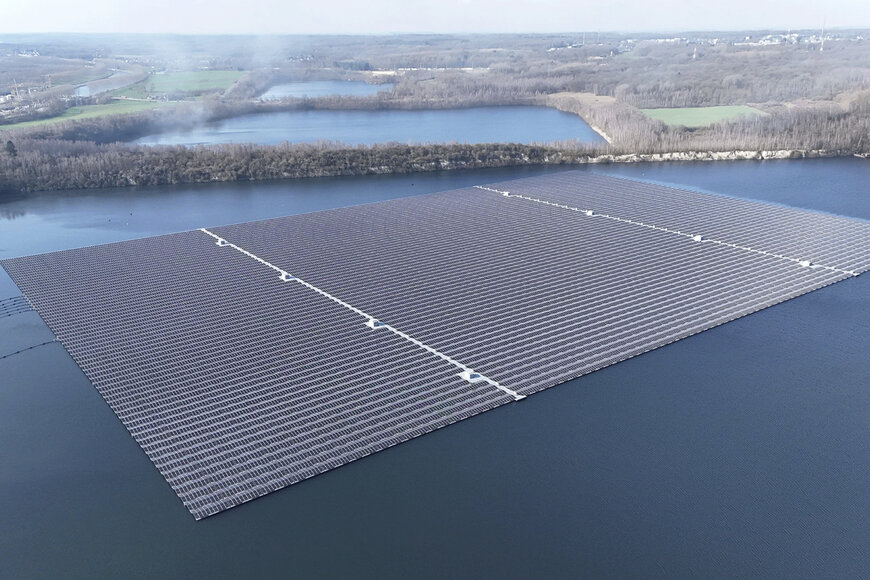
Industrial energy users are increasingly turning to on-site renewable generation to reduce emissions and stabilize energy costs. In Belgium, TotalEnergies has implemented a large-scale floating solar power plant designed specifically for industrial self-consumption, supplying renewable electricity directly to Holcim’s production facilities.
Installed at a rehabilitated chalk quarry site in Obourg, the floating photovoltaic system has a total capacity of 31 MW and generates approximately 30 GWh of electricity annually. This output is consumed on-site, reducing reliance on external power sources and supporting industrial decarbonization strategies.
Floating solar for industrial energy supply
The installation is built on a water surface created from a former quarry, demonstrating how industrial land can be repurposed for renewable energy production. Floating solar systems offer advantages in such environments by utilizing unused water bodies while avoiding competition with land-based infrastructure.
With an annual generation of 30 GWh, the system provides a significant share of the electricity demand for the connected industrial operations. This approach supports energy-intensive sectors such as cement production, where reducing indirect emissions from electricity consumption is a key challenge.
Grid connection and site integration
To connect the floating solar installation to the electrical substation, more than 700 meters of horizontal directional drilling were carried out. This method minimizes surface disruption and enables integration into existing industrial and natural landscapes without extensive excavation.
Such engineering solutions are essential in projects where environmental constraints and site rehabilitation requirements must be balanced with infrastructure development.
Supporting decarbonization in industry
The project illustrates the role of floating solar power plants in enabling industrial self-consumption of renewable energy. By generating electricity directly at the point of use, companies can reduce transmission losses and improve energy autonomy while lowering lifecycle emissions.
This type of installation is particularly relevant for industries with continuous energy demand, where stable and predictable renewable generation can be integrated into existing energy systems.
Industrial applications and scalability
Floating photovoltaic systems can be deployed across a range of industrial sectors, including mining, water treatment, and heavy manufacturing, especially where disused or water-filled sites are available. The scalability of such systems allows adaptation to different energy requirements, from pilot installations to multi-megawatt facilities.
The Obourg installation demonstrates how combining site rehabilitation with renewable energy infrastructure can create dual-use industrial assets, supporting both environmental restoration and energy transition objectives.
Edited by Industrial Journalist Natania Lyngdoh — Adapted by AI.
www.totalenergies.com
