
www.technology4environment.com
20
'26
Written on Modified on
TotalEnergies launches advanced plastics recycling plant in France
Pyrolysis-based facility converts non-recyclable household plastic waste into petrochemical feedstock for high-quality recycled plastics production.
totalenergies.com
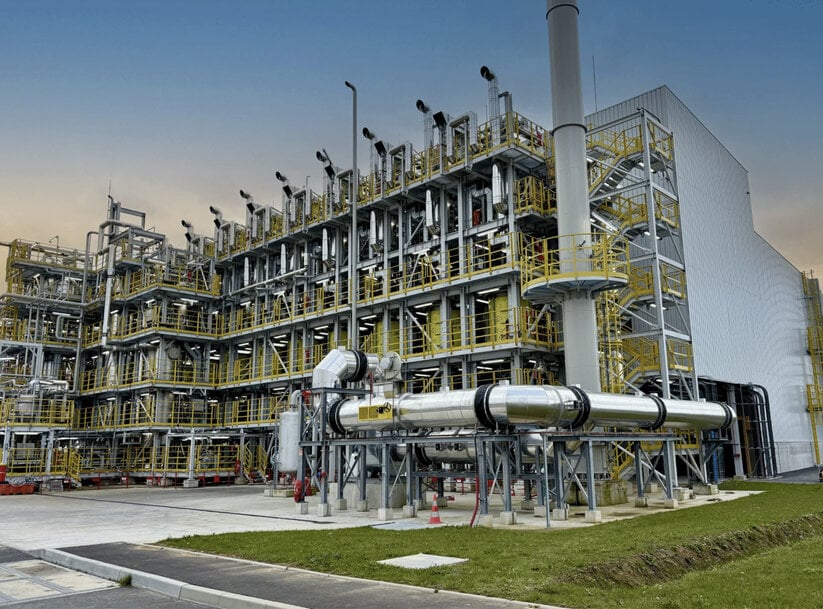
For plastics recycling, petrochemical processing, and circular economy applications, TotalEnergies has started production at an advanced recycling plant designed to convert hard-to-recycle plastic waste into synthetic oil using pyrolysis technology. The facility introduces a chemical recycling pathway capable of processing waste streams that cannot be treated through conventional mechanical methods.
Located at the Grandpuits site southeast of Paris, the plant has an annual processing capacity of 15,000 tonnes and forms part of the site’s transformation into a zero-crude industrial platform.
Converting non-recyclable waste through pyrolysis
The plant applies a pyrolysis process supplied by Plastic Energy, in which mixed plastic waste is heated at high temperatures in an oxygen-free environment under controlled pressure. This thermochemical process breaks down polymers into smaller hydrocarbon molecules, producing a synthetic oil suitable for further refining.
Unlike mechanical recycling, which is limited by contamination and material degradation, pyrolysis enables the treatment of complex and multi-layer plastics typically directed to landfill or incineration. This expands the range of recoverable materials within municipal waste streams.
Producing recycled plastics for high-specification applications
The synthetic oil generated through pyrolysis is used as a feedstock in petrochemical processes, partially replacing fossil-based inputs. This approach allows the production of recycled plastics with properties equivalent to virgin materials.
Such material quality is required for applications with strict regulatory constraints, including food-contact packaging and medical-grade products. By maintaining polymer performance, the process supports broader adoption of recycled content in high-value applications.
To ensure consistent feedstock supply, TotalEnergies signed agreements in 2023 with Citeo1 and Paprec, securing long-term sourcing of household plastic waste for the facility.
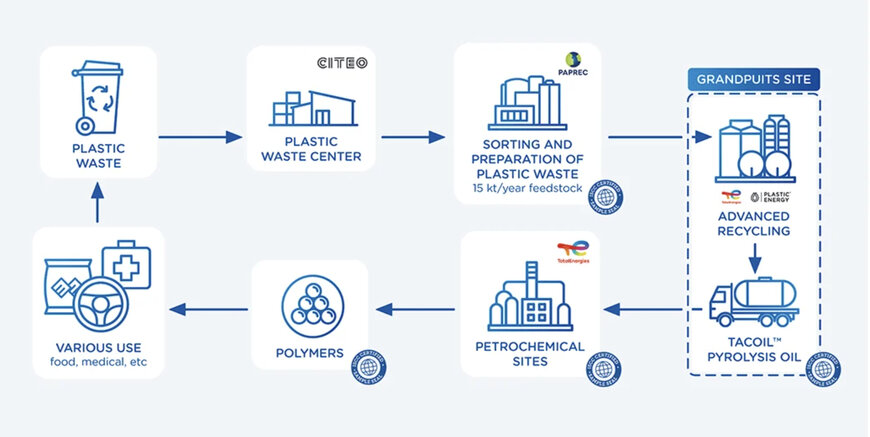
Integration into a zero-crude industrial platform
The commissioning of the recycling plant represents a key stage in the ongoing conversion of the Grandpuits refinery into a zero-crude platform focused on low-carbon and circular activities. This transition reflects a shift from traditional fossil-based refining toward alternative feedstocks and closed-loop material systems.
By integrating advanced recycling into an existing petrochemical site, the facility benefits from established infrastructure while reducing reliance on crude oil inputs. The approach also enables direct reintegration of recycled feedstock into industrial processes.
Enabling a new plastics recycling pathway
The deployment of chemical recycling at industrial scale contributes to the development of new recycling pathways in France, complementing existing waste management systems. It addresses limitations in current recycling rates by targeting waste fractions that are otherwise difficult to process.
“The start-up of the first advanced plastics recycling plant in France is an important milestone in the conversion of our Grandpuits site into a zero-crude complex,” stated Valérie Goff, adding that collaboration with Plastic Energy, Citeo1, and Paprec supports the development of a new recycling activity.
This project highlights the role of advanced recycling technologies in supporting circular material flows while meeting performance requirements across industrial sectors.
1 An eco-organisation dedicated to reducing the environmental impact of household packaging and paper.
Edited by Industrial Journalist, Natania Lyngdoh — Adapted by AI.
www.totalenergies.com
