
www.technology4environment.com
26
'25
Written on Modified on
Stora Enso Pushes Carbon Reduction Beyond Fossil-Free Cartonboard Mills
Verified low-carbon cartonboard production now shifts the focus from mill operations to supplier emissions, as further reductions depend increasingly on raw materials and value-chain collaboration.
www.storaenso.com

After years of operational decarbonisation, cartonboard production has reached a point where further carbon footprint reductions no longer come from major changes inside the mill. Instead, the next phase of progress depends on emissions embedded in raw materials, chemicals, and other upstream inputs. For producers with already low operational emissions, reducing climate impact has become a value-chain challenge rather than a purely industrial one.
Stora Enso reports that all products in its cartonboard portfolio now carry product carbon footprints calculated using a third-party verified life cycle assessment methodology. The verification covers packaging materials across its Cartonboard, Food Service, Liquid Packaging, and Containerboard business areas, following internationally recognised standards to ensure consistency, transparency, and comparability for customer reporting and packaging assessments.
From operational gains to upstream emissions
The verified figures reflect long-term investments in energy efficiency, electrification, and renewable energy across production sites. As a result, several mills now operate with limited remaining potential for further Scope 1 and 2 emission reductions. At this stage, additional improvements increasingly depend on Scope 3 emissions, particularly those associated with purchased materials.
This shift marks a structural change in how carbon performance is improved: from internal process optimisation to collaboration with suppliers and material developers.
Fossil CO₂-free board production in Sweden
The Fors cartonboard mill in Sweden represents the most advanced stage of this transition. It operates without fossil CO₂ emissions in Scope 1 and 2, having fully replaced fossil fuels with renewable energy sources. This has kept the carbon footprint of Fors-produced cartonboard at consistently low levels for several years.
Because operational emissions are already minimised, further reductions depend primarily on upstream inputs. One recent example is the introduction of lower-CO₂ calcium carbonate, which reduces product footprints even where baseline emissions are already low.
Long-term efficiency gains in Finland
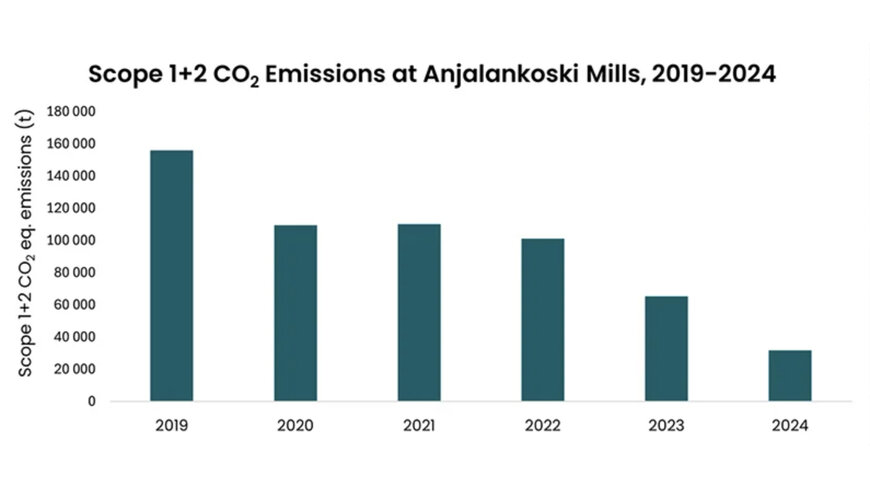
At the Anjalankoski site in Finland, carbon reduction has been achieved through gradual, long-term improvements rather than a single transformation. Equipment upgrades, electrification, and increased use of renewable energy have steadily lowered emissions while maintaining production efficiency.
As with Fors, Anjalankoski is approaching the limits of what can be achieved within mill operations alone. Future reductions will therefore depend on supplier engagement and raw material innovation rather than further on-site energy changes.
Scaling high-yield materials at Oulu
The Oulu site in Finland represents a newer phase of development, currently ramping up production of lightweight, high-yield packaging materials. Higher material yield means more output from the same volume of raw material, directly improving resource efficiency and lowering carbon intensity per tonne of product.
While the site is still progressing toward full production capacity, early indicators point to strong carbon performance driven by efficient design and advanced environmental controls.
Group-level climate commitments and progress
The cartonboard business sits within broader group climate targets. Stora Enso has committed to reducing absolute Scope 1, 2, and 3 emissions by 50% by 2030 compared with a 2019 baseline, a target validated by the Science Based Targets initiative. The company has also pledged to reach net zero emissions by 2040 and climate positivity by 2050.
To date, reported reductions include a 53% decrease in Scope 1 and 2 emissions and a 39% reduction in Scope 3 emissions, exceeding the 2030 operational target ahead of schedule.
Implications for packaging customers
For converters, brand owners, and retailers, verified low-carbon cartonboard provides a measurable advantage in reducing overall packaging system emissions. With operational emissions already low, product footprints start from a strong baseline and are supported by independently verified data suitable for regulatory reporting and sustainability disclosures.
As emission reductions increasingly depend on upstream materials, further progress will rely on collaboration across the packaging value chain. In this context, transparency, supplier innovation, and shared climate objectives become as critical as mill-level efficiency in achieving continued reductions.
www.storaenso.com
