
www.technology4environment.com
02
'25
Written on Modified on
How Fortescue Is Differentiating Its Operations With Battery Energy Storage Systems
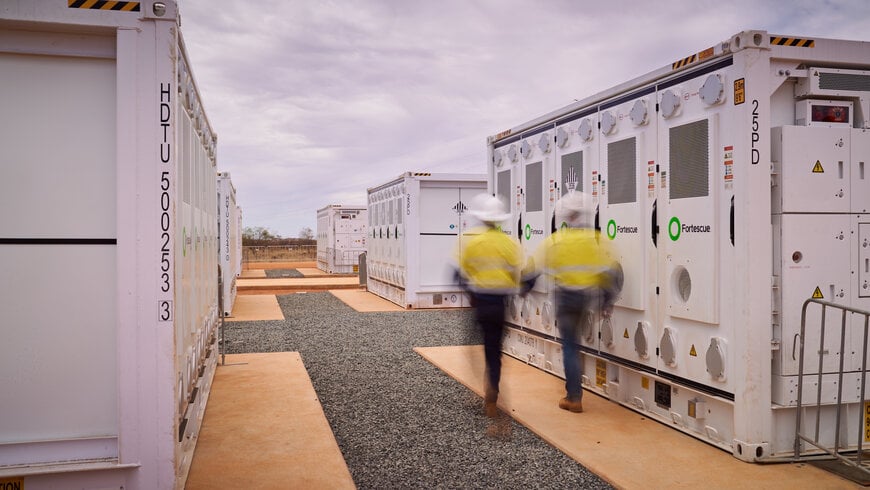
The 250MWh BYD Battery Energy Storage System at North Star Junction is a key milestone in Fortescue's ambitious plan to replace fossil fuels and achieve net-zero operations in the Pilbara.
www.fortescue.com
Large-scale Battery Energy Storage Systems (BESS) are emerging as critical infrastructure for mining companies seeking to replace fossil-fuel generation with renewable power. In remote regions such as Western Australia's Pilbara, these systems enable operators to store excess solar energy and deliver stable, dispatchable electricity to mine sites after sunset. Fortescue’s rollout of industrial-scale storage marks one of the most advanced applications of this technology in the global mining sector.
A Large-Scale System That Signals a Competitive Shift
Fortescue has deployed its first large-scale BESS at North Star Junction (NSJ), positioning itself ahead of most global mining competitors in terms of storage scale and decarbonisation ambition. The installation—powered by BYD’s Blade Battery technology—is the first step in a planned 4–5 GWh storage program that will underpin Fortescue’s transition to renewable energy across its Pilbara iron ore operations.
Unlike conventional diesel- or gas-supported systems still used widely in mining, Fortescue’s model replaces thermal backup with long-duration, containerised storage capable of five hours of continuous power delivery. This approach improves energy reliability while markedly reducing fossil fuel dependence.
Technical Characteristics and Operational Purpose
The NSJ BESS consists of 48 storage containers delivering a total capacity of 250 MWh. The system can supply up to 50 MW of power to the Pilbara Energy Connect (PEC) network, shifting daytime solar generation into the night to ensure grid stability and consistent mine operations.
The Blade Battery technology selected for the project is engineered for thermal safety, long cycle life, and stable performance under high temperatures—an essential requirement in the Pilbara environment. Its liquid-cooled architecture contributes to system reliability, an area in which Fortescue aims to set a benchmark for large-scale mining applications.
Strategic Role in Fortescue’s Decarbonisation Program
This first installation marks a foundational component of Fortescue’s broader electrification strategy. The company is progressing toward a multi-gigawatt storage portfolio that supports its renewable energy ecosystem, including the 190 MW Cloudbreak Solar Farm and more than 460 km of newly constructed transmission lines.
Fortescue’s next BESS project—a 120 MWh installation at Eliwana—is scheduled for delivery and commissioning in early 2026, extending the company’s early-mover advantage in large-scale storage adoption within the mining industry.
A Key Step Toward a Fully Renewable Pilbara
By integrating long-duration storage into a network designed for high solar penetration, Fortescue is reshaping the operational model for energy-intensive mining. The NSJ BESS demonstrates how containerised storage, paired with advanced lithium-iron-phosphate battery systems, can provide both reliability and emissions reductions at industrial scale.
This deployment positions Fortescue as one of the first major miners to implement a multi-gigawatt storage roadmap—an approach that differentiates it in the global transition toward renewable-powered mining operations.
