
www.technology4environment.com
13
'26
Written on Modified on
Kawasaki Launches Automated Production Line for Liquefied Hydrogen Plant Piping
New facility at Harima Works automates double-wall piping fabrication and completes initial spool shipment to advance Japan’s commercial-scale liquefied hydrogen supply chain demonstration project.
www.kawasakirobotics.com
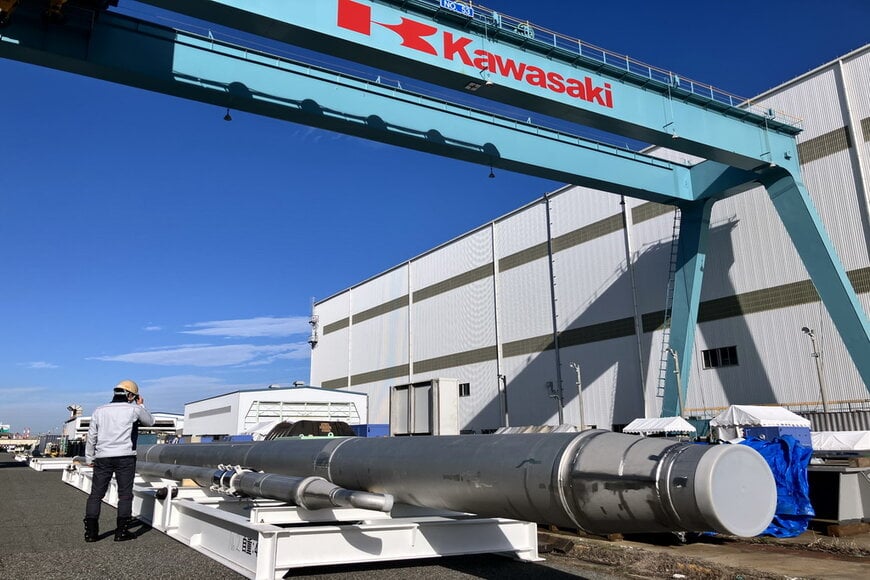
Kawasaki Heavy Industries has established an automated manufacturing line for vacuum-insulated double-wall piping at its Harima Works in Hyogo Prefecture to supply commercial-scale liquefied hydrogen infrastructure. This deployment supports the Liquefied Hydrogen Supply Chain Commercialization Demonstration Project promoted by the New Energy and Industrial Technology Development Organization (NEDO).
Industrial Scaling and Technical Challenge
Transporting liquefied hydrogen requires maintaining cryogenic temperatures at -253°C while minimizing external thermal ingress. Vacuum-insulated double-wall piping addresses this by maintaining an evacuated annular space lined with multilayer insulation between inner and outer pipes.
Compared to the 2020 pilot demonstration at the Hy touch Kobe receiving terminal, commercial-scale deployment increases the required number of prefabricated piping units, known as spools, by approximately 33 times. Simultaneously, the maximum inner pipe diameter increases by approximately 2.3 times. Meeting these volume and dimensional requirements necessitated industrial automation across machining, welding, and inspection workflows to reduce manufacturing lead times and control production variability.
Automated Production Architecture
Representing an investment of approximately 2 billion yen across a 5,400-square-meter floor area, the facility divides fabrication into two primary automated stages using proprietary robotics and dedicated machinery:
The raw-pipe processing line executes automated pipe marking, cutting, machining, and the welding of small auxiliary components.
The subassembly line performs automated butt welding of piping components, nondestructive testing, and wrapping of multilayer insulation before inner and outer pipes are joined into completed spools.
Because each spool features custom dimensions, lengths, and geometries, parameter management is critical. Individual components are assigned two-dimensional codes that allow production equipment to automatically retrieve exact processing parameters and maintain component traceability. The system also collects machine operating data continuously for process analysis and defect prevention.
Deployment and Supply Chain Integration
On November 10, 2026, Kawasaki Heavy Industries completed the initial shipment of factory-fabricated spools from Harima Works to the Kawasaki LH2 Terminal under construction in Ogishima, Kawasaki City, Kanagawa Prefecture.
To maintain continuity between factory fabrication and field construction, the two-dimensional code tracking system extends to on-site installation workflows at the receiving terminal. While NEDO oversees the broader Green Innovation Fund commercialization framework, Kawasaki Heavy Industries manages engineering, automated equipment integration, and component manufacturing.
Operational Impact
Transitioning from manual fabrication to automated, data-monitored production enables repeatable weld integrity and consistent thermal insulation performance across high-volume cryogenic piping runs. Standardized parameter control and automated nondestructive testing reduce bottlenecks in heavy infrastructure manufacturing, supporting the technical feasibility of large-scale liquefied hydrogen receiving and distribution terminals.
Edited by Evgeny Churilov, Induportals Media - Adapted by AI.
www.global.kawasaki.com
