
www.technology4environment.com
09
'26
Written on Modified on
Diodes launches dual-channel isolated gate drivers for power switching
The new API21550 and API21552 series offer robust capacitive isolation and high CMTI for WBG transistors.
www.diodes.com
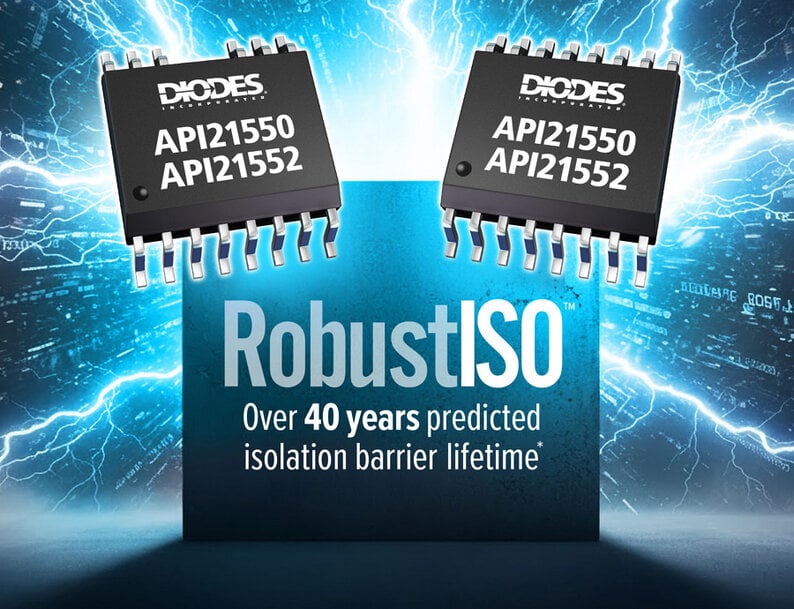
Diodes Incorporated has expanded its RobustISO™ family with the release of the API21550 and API21552 series of dual-channel isolated gate drivers. Showcased at electronica 2026, these devices are designed for demanding power-switching applications, including motor drives, solar inverters, battery management systems, and high-voltage DC-DC converters. Utilizing a silica-based capacitive isolation barrier, the drivers can withstand breakdown voltages up to 13 kVRMS with a projected barrier lifetime exceeding 40 years. To prevent catastrophic shoot-through in half-bridge configurations, the API21550 features separate high- and low-side outputs with adjustable deadtime, while the API21552 provides dual independent outputs for versatile high- or low-side driving topologies.
High transient immunity for wide-bandgap applications
To ensure absolute signal integrity in electrically noisy environments, both components deliver a minimum common mode transient immunity (CMTI) of 150 V/ns. The drivers supply a robust 4A source and 6A sink peak current, boasting rapid 40 ns propagation delays and a minimal pulse-width distortion of just 7 ns. Integrated safety and performance features—such as a 5 ns de-glitch filter, active pulldown, and undervoltage lockout (UVLO) on both input and output rails—make the series fully compatible with traditional silicon MOSFETs and IGBTs, as well as next-generation wide-bandgap (WBG) silicon carbide (SiC) and gallium nitride (GaN) power devices. Automotive-qualified (Q) versions are also available for e-mobility infrastructure.
Additional Context: High dV/dt switching transients and Capacitive Isolation
This section details the physics of Common Mode Transient Immunity (CMTI) and wide-bandgap driving not included in the original press release.
With the industry shift from traditional silicon IGBTs to wide-bandgap semiconductors like Silicon Carbide (SiC) and Gallium Nitride (GaN), power switches can now transition between on and off states in mere nanoseconds. While this drastically reduces switching power losses, it creates extreme voltage slew rates (high dV/dt) across the half-bridge nodes. In an isolated gate driver, these violent voltage transients can inject a parasitic displacement current across the internal isolation barrier (I = C × dV/dt). If the driver lacks sufficient Common Mode Transient Immunity (CMTI), this parasitic current can corrupt the digital control signal, potentially triggering a false turn-on of the transistor and causing a catastrophic shoot-through short circuit.
To achieve a high CMTI of 150 V/ns, modern devices utilize a silica-based (SiO2) capacitive isolation architecture. Unlike legacy optocouplers that rely on internal LEDs (which suffer from luminous degradation over time and slow response speeds), capacitive isolators transmit digital signals across microscopic, high-voltage internal capacitors using high-frequency On-Off Keying (OOK) modulation. This ensures pristine logic integrity, microsecond-level timing precision, and multi-decade operational lifespans even in the harshest power electronics environments.
Edited by an industrial journalist, Lekshman Ramdas, with AI assistance.
www.diodes.com
