
www.technology4environment.com
09
'26
Written on Modified on
Offshore Carbon Capture Storage Platform Installation
Eni CCUS Holding and Global Infrastructure Partners completed the installation of the Douglas CCS platform to inject captured carbon into depleted gas fields.
www.eni.com
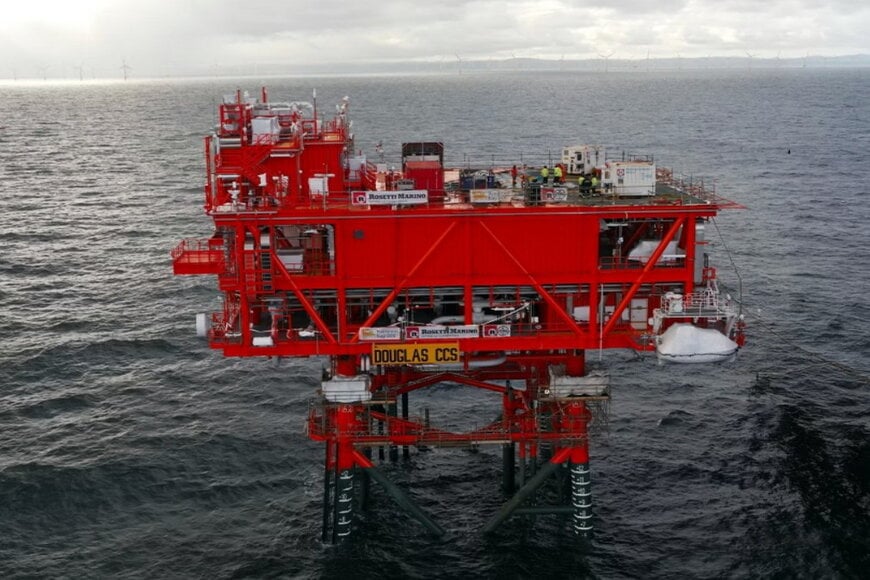
Eni CCUS Holding, a joint venture between Eni and Global Infrastructure Partners, has installed the Douglas CCS offshore platform in Liverpool Bay to serve as the operational hub for regional carbon dioxide transportation and storage. The facility functions as the core offshore digital infrastructure and handling point for the HyNet industrial decarbonisation cluster, processing captured emissions from heavy industries across North West England and North Wales.
System Architecture and Structural Specifications
The Douglas CCS installation provides the physical routing and manifold interface needed to receive industrial emissions transported from onshore capture plants. The structure comprises an offshore jacket weighing 1,755 tonnes, anchored to the seabed with eight foundation piles totalling 730 tonnes, and topped with 1,885-tonne topside processing facilities.
Eni CCUS Holding manages the integration of purpose-built structures with legacy offshore assets. The newly installed platform interfaces directly with an existing offshore pipeline network. Rather than installing entirely new subsea lines, engineers repurposed existing hydrocarbons transport conduits to move dense-phase carbon dioxide from the platform to offshore geological formations.
Geological Storage and Industrial Operations
The platform controls the injection of carbon dioxide into depleted natural gas reservoirs located beneath Liverpool Bay for permanent storage. Using legacy hydrocarbon reservoirs provides well-documented containment mechanics and proven geological trapping characteristics, reducing exploratory uncertainty during deep subsea sequestration.
This operational configuration supports hard-to-abate manufacturing sectors, including chemicals, refining, and cement manufacturing, that require centralized transport networks to isolate process emissions.
Project Execution and Network Integration
Delivery of the platform required an integrated engineering, procurement, construction, and commissioning schedule completed within 18 months of initial contract award. The deployment of the Douglas platform advances the broader Liverpool Bay CCS infrastructure network to approximately 50 percent completion.
The engineering model relies on continuous pipeline integration to maintain pressure and flow parameters across onshore and offshore boundaries, ensuring process stability over an anticipated operating window exceeding 25 years.
Edited by Evgeny Churilov, Induportals Media - Adapted by AI.
www.eni.com
