
www.technology4environment.com
24
'26
Written on Modified on
ebm-papst Expands Industrial Energy Storage and Photovoltaics in Hungary
Integration of distributed battery storage and solar capacity strengthens manufacturing resilience and optimizes self-consumption rates for industrial production facilities.
www.ebmpapst.com
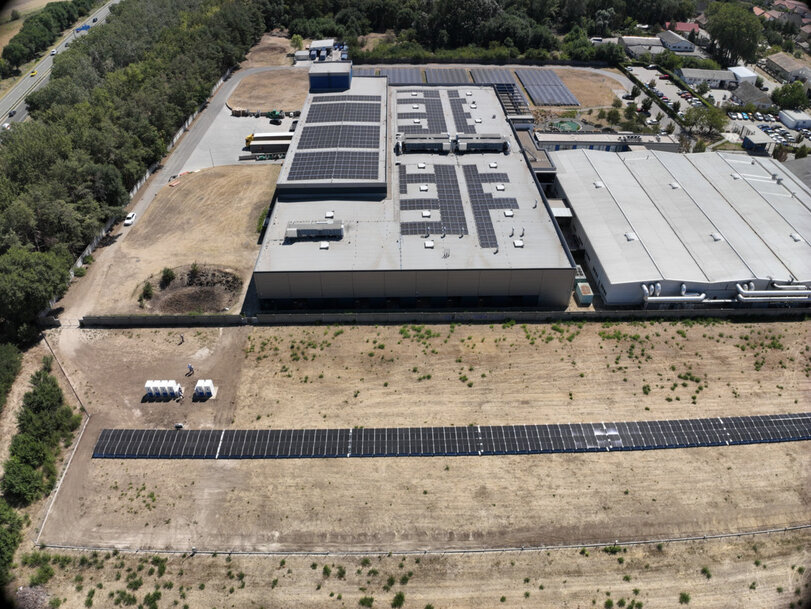
ebm-papst Hungary is expanding the decentralized energy generation and storage infrastructure at its Vecsés manufacturing plant through an investment of approximately 570,000 euros. The project incorporates an additional 100 kW of photovoltaic generation alongside a 1,572 kWh commercial battery energy storage system to supply ongoing ventilation and drive-technology production operations.
Decentralized Generation and Microgrid Resilience
The installation adds to an established 800 kW photovoltaic array, bringing the total on-site solar generation capacity to 900 kW. To manage the intermittent generation profiles of the expanded array, the facility integrated a stationary energy storage system comprising six individual battery modules, each weighing roughly 2.5 tonnes.
The primary engineering function of the battery installation is peak shaving, load balancing, and uninterrupted emergency operation. If grid connectivity fails, a fully charged 1,572 kWh reserve delivers sufficient energy to sustain manufacturing lines for three to four consecutive hours. This operational buffer prevents abrupt downtime, equipment damage, and batch loss across precision assembly operations.
Energy Yield and Financial Return Parameters
Before this installation, the existing 800 kW solar array fulfilled an average of 25 percent of the Vecsés plant's annual electricity demand. Coupling the additional 100 kW array with dedicated battery buffering yields approximately 400 MWh of usable energy annually on-site, elevating the facility's total electricity self-sufficiency metric to approximately 45 percent.
The financial performance of the system is tied directly to mitigating exposure to volatile day-ahead wholesale electricity markets. By absorbing peak midday solar generation for discharge during higher-tariff demand windows, the system delivers an amortisation cycle estimated at under 3.5 years. The architecture also incorporates modular integration points, allowing scalable expansion of storage capacity as facility energy demands rise.
According to Sándor Egri, Head of the Facility and Maintenance Department, the battery storage architecture acts as an operational foundation that reduces operational reliance on external distribution network anomalies while stabilizing internal load demands.
Róbert Radics, Managing Director of ebm-papst Hungary, stated that expanding the facility's power infrastructure operationalizes corporate environmental, social, and governance objectives through measurable resource management and capital investments in technical site development.
Additional Context:
This section details technical specifications and competitive benchmarking not included in the original product announcement
Industrial battery energy storage systems (BESS) installed behind the meter typically employ lithium iron phosphate (LFP) chemistry due to its thermal stability and cycle life, operating against alternatives such as nickel manganese cobalt (NMC) formulations. Within European commercial and industrial (C&I) environments, comparable stationary installations—such as the Tesla Megapack-based commercial tiers, the Siemens SieStorage portfolio, and the BYD Energy Cube—standardize around containerized or modular outdoor enclosures.
In competitive benchmarks for commercial industrial microgrids, cycle lifespans generally range between 4,000 and 6,000 full cycles at 80 percent depth of discharge (DoD) before degradation reduces nominal capacity below 70 percent. The energy-to-power discharge duration indicated by the ebm-papst system (delivering 1,572 kWh across three to four operating hours) reflects a C-rate between 0.25C and 0.33C, aligning with established industry standards for stationary solar-firming and emergency bridging, compared to high-rate frequency-regulation systems which operate at 1C to 2C discharge rates.
Edited by Natania Lyngdoh, Induportals editor, assisted by AI.
www.ebmpapst.com
