
www.technology4environment.com
23
'26
Written on Modified on
Industrial Waste Heat Integration for District Energy Networks
Danfoss collaborates with industrial operators and district heating networks to implement thermal recovery systems across high-density facilities.
www.danfoss.com
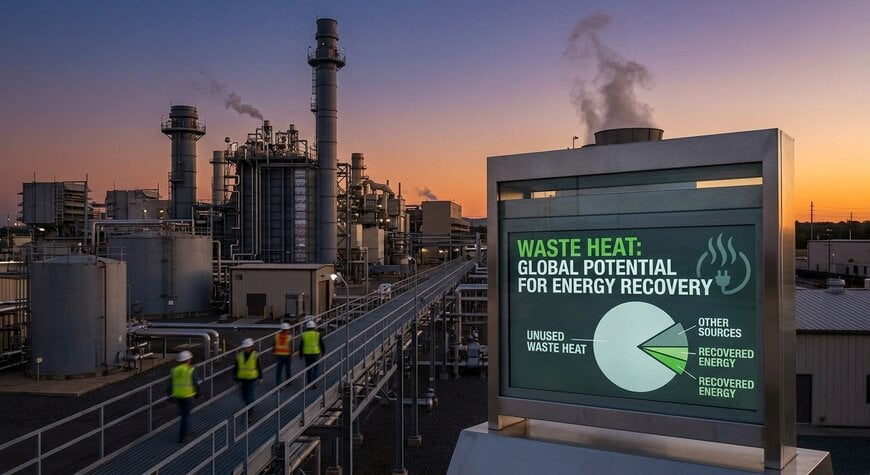
Danfoss has developed an engineering framework alongside municipal network operators and industrial facilities to integrate recovered thermal energy into existing municipal heating grids. This cooperative engineering approach targets energy-intensive operations, including continuous-load data centers, manufacturing plants, and wastewater facilities, to offset natural gas consumption.
Industrial and Operational Challenges
Industrial facilities generate significant excess thermal energy during standard manufacturing and processing cycles. In 2023, approximately 3,100 TWh of excess thermal energy remained uncaptured worldwide. High-density compute facilities and manufacturing sites traditionally dissipate this thermal output through cooling towers and ambient heat rejection units. Municipal district energy systems simultaneously combust fossil fuels to generate low-temperature hydronic heating, creating parallel thermodynamic inefficiencies across adjacent sectors.
Technical Architecture and Implementation
The deployment integrates mechanical heat-recovery exchangers and industrial heat pumps directly into facility cooling circuits. Danfoss provides heat exchange hardware, variable frequency drives, and pressure management components, while municipal energy operators configure the hydraulic interconnections to municipal pipelines.
The thermal exchange occurs at the primary heat-rejection stage of the partner facility. Closed-loop liquid cooling circuits route thermal effluent into plate heat exchangers. Centrifugal heat pumps then elevate low-grade thermal discharge to operating network temperatures, typically between 70°C and 90°C. Microgrids and localized industrial clusters allow neighboring facilities to act as complementary producers and consumers of low-enthalpy water.
Applications and Quantitative Results
Primary implementations target continuous baseload emitters, particularly data centers and metal processing installations. In Denmark, an aluminum manufacturing plant integrated on-site thermal recovery to eliminate internal gas demand for water and space heating, reducing natural gas usage by 205,600 cubic meters annually.
Analysis of German infrastructure indicates that existing industrial emitters can supply over 30 percent of the nation's district heating baseline, excluding combined heat and power plants. Integrating Germany's 3,000 data centers provides a stable, year-round source of uncaptured heat due to constant server operation, shortening investment payback cycles while stabilizing network hydronic loops.
Industry Perspective
Regarding system deployment requirements, Kristian Strand noted: "The technology is here. The opportunity is here. Now we need the energy system to catch up. Industry must make heat recovery standard practice, energy operators must make connections easier, and governments must remove the barriers that make electricity more expensive than gas for these investments."
Edited by Evgeny Churilov, Induportals Media - Adapted by AI.
www.danfoss.com
