
www.technology4environment.com
03
'26
Written on Modified on
Liebherr Tower Cranes Support Amazon Rainforest Climate Research
Liebherr 85 EC-B tower cranes provide canopy access for the AmazonFACE programme, enabling scientists to study the impacts of rising CO₂ levels while minimizing environmental disturbance.
www.liebherr.com
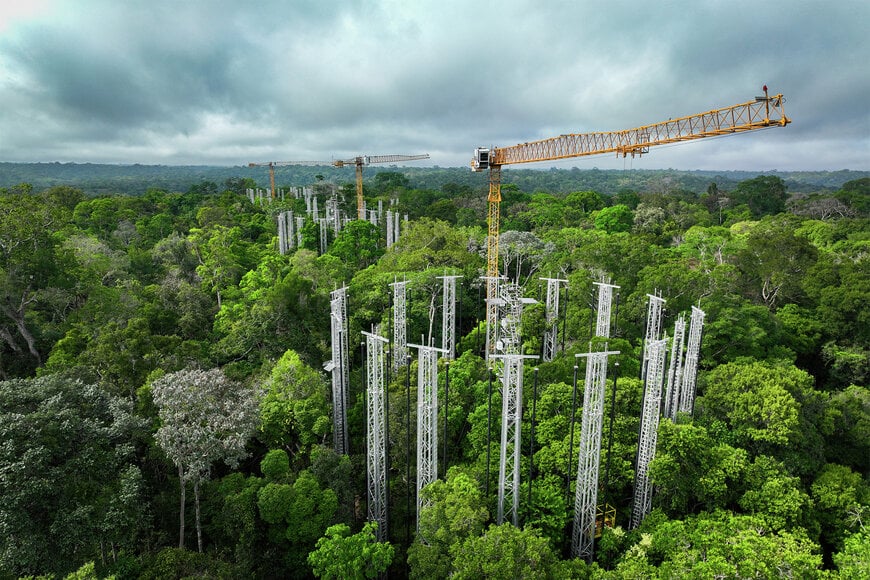
Liebherr plans to support the AmazonFACE scientific partnership by deploying four 85 EC-B flat-top tower cranes for environmental monitoring within the Brazilian rainforest. This infrastructure provides climate researchers with vertical access to old-growth forest strata to collect atmospheric data and study ecosystem responses to elevated carbon dioxide levels.
Atmospheric Enrichment Observation Infrastructure
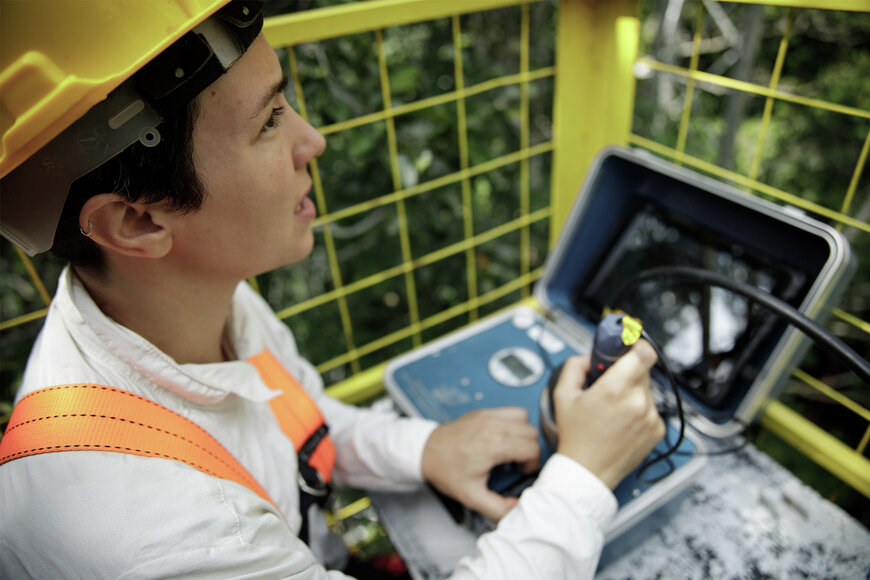
The AmazonFACE program operates as a scientific partnership led by the National Institute for Amazonian Research and the University of Campinas, exposing an intact section of old-growth Amazon rainforest to elevated carbon dioxide concentrations. Operating in collaboration with the UK Met Office and over 150 specialists, the initiative observes how the forest canopy, soil, and carbon uptake dynamics respond to projected atmospheric conditions. Researchers utilize the canopy access technology to measure whether the estimated 150 to 200 billion tonnes of carbon stored in the Amazon basin will grow, remain stable, or diminish. Outputs from this data collection are designed to inform regional policy and international climate frameworks, including the environmental commitments discussed at COP30, which took place in Belem, Brazil, in November 2025.
Vertical Access Technology for Environmental Preservation
The deployment of tower cranes rather than scaffolding structures or elevated walkways serves to minimize environmental disruption. A tower crane mast occupies a minimal ground footprint, reducing soil disturbance, root system damage, and canopy opening requirements within the protected forest area. The horizontal reach of the equipment allows a single unit to cover a wide experimental plot without repositioning, preventing repeated ground interference. The four lifting units raise researchers safely to heights exceeding 45 meters, enabling direct measurement of plant physiology, microclimate parameters, and biodiversity indicators within the enriched atmospheric zone.
Flat-Top Crane Mechanics and Load Stability
The selection of the 85 EC-B units addresses specific spatial and operational constraints inherent to dense canopy environments. The crane features a maximum jib length of 50 meters and a lifting capacity of 5,000 kilograms. Its flat-top design eliminates the traditional A-frame head, reducing the overall height above the jib. This architectural element allows multiple cranes to operate in overlapping radius zones without structural interference, ensuring complete coverage of the experimental plots. Furthermore, the frequency-controlled drives provide smooth acceleration and deceleration across the hoist and slewing axes. This mechanical precision minimizes vibration during vertical travel, allowing sensitive scientific instruments, including gas analyzers and atmospheric sensors, to be transported without damage from mechanical shock. Application engineer Bruna Prisco indicates that the units were selected because they can withstand extremes of heat and humidity without disturbing the habitat.
Operational Continuity and Site Logistics
Maintaining complex lifting equipment in remote rainforest environments requires sustained logistical frameworks. Two of the units were manufactured at a production facility in Brazil, while the remaining two were produced in Spain. Ongoing operational continuity is supported through operator training, maintenance instruction, spare parts supply, and technical assistance, ensuring the hardware remains functional despite limited regional logistics infrastructure.
Additional Context:
This section details technical specifications and competitive benchmarking not included in the original product announcement
In the 85-tonne-meter equipment class, flat-top cranes are evaluated on parameters such as jib modularity, maximum tip load, and spatial efficiency. Comparable models operating in this capacity bracket include the Potain MCT 88 and the Linden Comansa 11LC90, both of which offer similar 52-meter jib lengths and 5,000-kilogram maximum lifting capacities. Standard benchmarking for remote scientific deployment prioritizes frequency-controlled variable drives over raw hoisting speed, as precise positioning accuracy is required to prevent load sway during personnel and sensor transit. Furthermore, the flat-top architecture represents the industry standard for multi-crane sites with strict height restrictions, directly competing with older hammerhead designs that require substantially greater vertical clearance to operate safely in overlapping configurations.
Edited by Natania Lyngdoh, Induportals editor, assisted by AI.
www.liebherr.com
