
www.technology4environment.com
27
'26
Written on Modified on
Hydrometallurgical Process for Lithium Carbonate Production
Metso has introduced a new lithium carbonate production technology designed to improve yield, reduce operating costs, and simplify the refining of battery materials.
www.metso.com
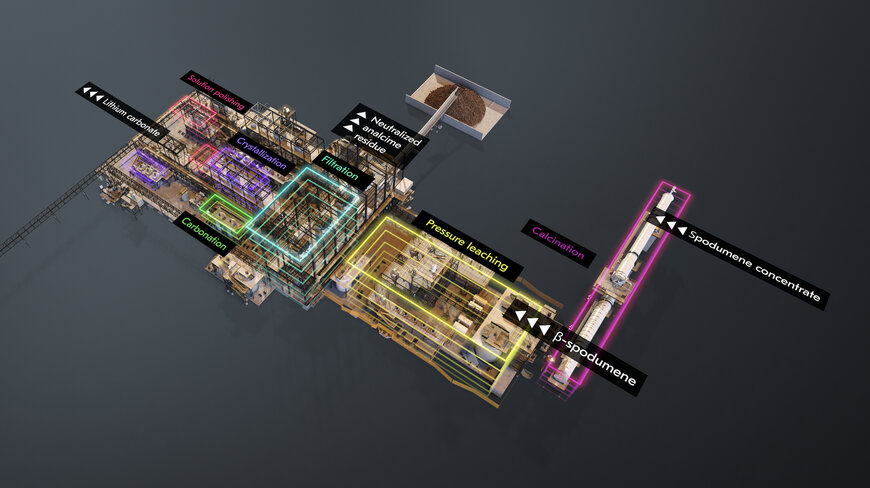
Metso has launched a next-generation lithium carbonate production process based on spodumene concentrate, designed to produce battery-grade lithium carbonate in a single refining stage. The hydrometallurgical technology targets applications related to lithium iron phosphate (LFP) batteries, energy storage systems, and transport electrification.
The process expansion comes as global lithium demand continues to increase due to growing battery storage capacity, renewable energy integration, and electric vehicle production. Through this development, Metso aims to strengthen its portfolio of critical mineral processing technologies supporting the energy transition.
Single-Pass Lithium Carbonate Production
Metso’s process converts spodumene into battery-grade lithium carbonate using a single-pass refining approach that minimizes intermediate processing stages. The technology reduces plant complexity and avoids unwanted by-products such as sodium sulfate.
According to the company, reducing the number of process stages lowers capital expenditure, improves operational stability, and accelerates plant ramp-up.
The process is based on hydrometallurgical alkaline leaching technology using soda pressure leaching. This method enables selective lithium extraction while limiting the dissolution of impurities. The associated carbonation-decarbonation process directly produces battery-grade lithium carbonate without requiring additional purification stages.
Neutralized Residue Management and Circular Metallurgy Development
Metso states that the mineral residue produced during the carbonation process exits in a neutralized state, simplifying disposal or industrial reuse. This characteristic may reduce the need for additional waste treatment in mining and chemical processing operations.
The company is also developing a circular metallurgy concept aimed at regenerating the chemicals used in the alkaline leach process. This approach could reduce reagent consumption and improve the environmental efficiency of lithium refining facilities.
Hydrometallurgical processes are becoming increasingly important in the battery materials supply chain because of their potential to reduce certain emissions associated with conventional pyrometallurgical methods while improving recovery of critical minerals.
Expansion of Metso’s Lithium Technology Portfolio
Metso reports more than 20 years of experience in developing alkaline leaching technologies for hard rock lithium ores. The new lithium carbonate process complements the company’s existing lithium hydroxide production technologies.
Together, these technologies allow mining companies and battery material producers to optimize operations from ore beneficiation through the production of battery-grade lithium chemicals.
Marika Tiihonen, Technology Manager for Lithium at Metso, stated that combining the company’s thermal and hydrometallurgical technologies with complete industrial flowsheet engineering capabilities is intended to deliver high plant availability and improve operational reliability and safety.
The process development also addresses increasing global demand for LFP batteries, which primarily use lithium carbonate as a cathode material feedstock.
Additional Context: Technical Specifications and Competitive Benchmarking
Lithium refining from spodumene generally relies on two main process categories: sulfuric acid-based refining and alkaline hydrometallurgical refining. Conventional sulfuric acid processes typically use high-temperature acid roasting, while alkaline processes such as Metso’s use pressure leaching with alkaline solutions to reduce certain impurities and chemical by-products.
Comparable technologies are offered by companies including Albemarle, Ganfeng Lithium, Tianqi Lithium, and Livent, all of which produce battery-grade lithium carbonate or lithium hydroxide from spodumene ores or lithium brines.
Common benchmarking criteria in lithium refining include lithium extraction yield, energy consumption, reagent consumption, by-product generation, operating costs, and final lithium carbonate purity. Single-pass refining technologies are increasingly valued for reducing purification stages and simplifying industrial plant integration.
The expansion of LFP battery production for electric vehicles and stationary energy storage is also increasing global demand for lithium carbonate, while nickel-manganese-cobalt (NMC) battery chemistries often require higher volumes of lithium hydroxide in specific cathode formulations.
Edited by Sucithra Mani, Induportals editor – adapted by AI.
www.metso.com
