
www.technology4environment.com
23
'26
Written on Modified on
Solar Self-Consumption for Wastewater Treatment Facilities
Eiffage Énergie Systèmes deployed a photovoltaic system with intelligent energy controls at a French treatment plant.
www.eiffage.com
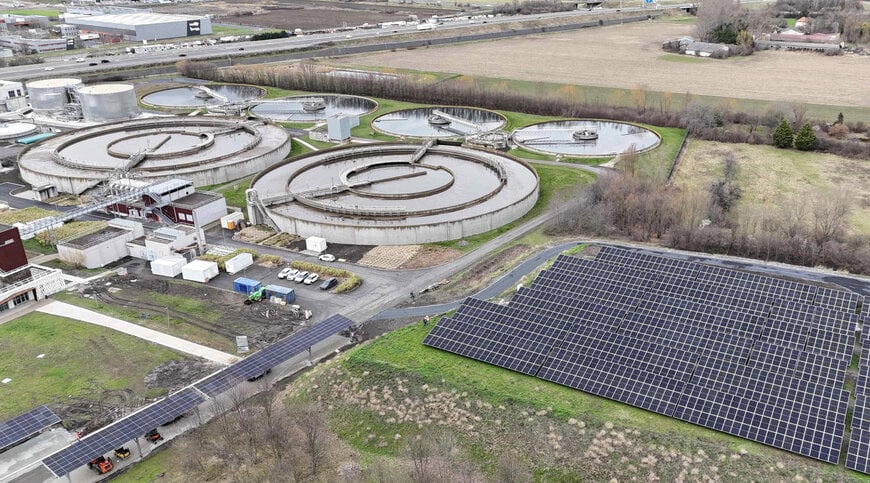
Eiffage Énergie Systèmes, in partnership with NGE, participated in the construction of a photovoltaic power plant designed to supply energy to the Clermont-Ferrand wastewater treatment plant in the Puy-de-Dôme region of France. The project aims to increase the site’s energy autonomy while integrating intelligent energy management solutions adapted to the operational constraints of water treatment infrastructure.
Industrial Applications and Energy Objectives
With an installed capacity of 802.3 kWp, the photovoltaic installation is fully dedicated to on-site self-consumption. The 1,353 solar panels are distributed across a 5,000 m2 ground-mounted installation and 500 m2 of photovoltaic car park canopies. The system is expected to cover between 10 and 15% of the facility’s energy demand.
The project forms part of a broader strategy focused on resource optimization and reducing dependence on the external power grid for industrial wastewater treatment operations.
Division of Technical Responsibilities
The project involved several specialized stakeholders. Eiffage Énergie Systèmes acted as the lead contractor, while NGE participated as co-contractor. Clermont Auvergne Métropole served as project owner, SPL Clermont Auvergne as delegated project owner, and Artelia as engineering consultant.
The scope of work included preliminary engineering studies, earthworks, roadworks and utility networks, foundations, installation of metal structures and photovoltaic panels, as well as electrical cabling for the solar plant.
The teams also completed inverter connections and integrated the installation into the existing electrical infrastructure of the treatment facility, including the construction of a high-voltage substation designed to ensure compatibility with the site’s industrial electrical network.
Energy Management and Industrial Supervision
One of the project’s main technical challenges involved controlling energy flows to prevent electricity injection into the public grid. A zero-export control loop was implemented to continuously adjust photovoltaic production to the plant’s actual energy consumption.
The system also incorporates a remote decoupling function activated either upon request from Enedis or during the startup of backup generators. The photovoltaic plant was integrated into the wastewater facility’s existing industrial supervision platform, enabling centralized monitoring and control of the energy infrastructure and associated equipment.
According to Antoine Ballet, project manager: “This project is part of a broader approach focused on resource optimization and industrial performance.”
Edited by Maria Brueva, Induportals editor – adapted by AI.
www.eiffage.com
