
www.technology4environment.com
21
'26
Written on Modified on
Waste-to-Energy Plant Advances Rome Circular Economy
Kanadevia Inova will lead construction of a 600,000-tonne annual waste-to-energy facility for Rome under a 30-year concession.
kanadevia-inova.com
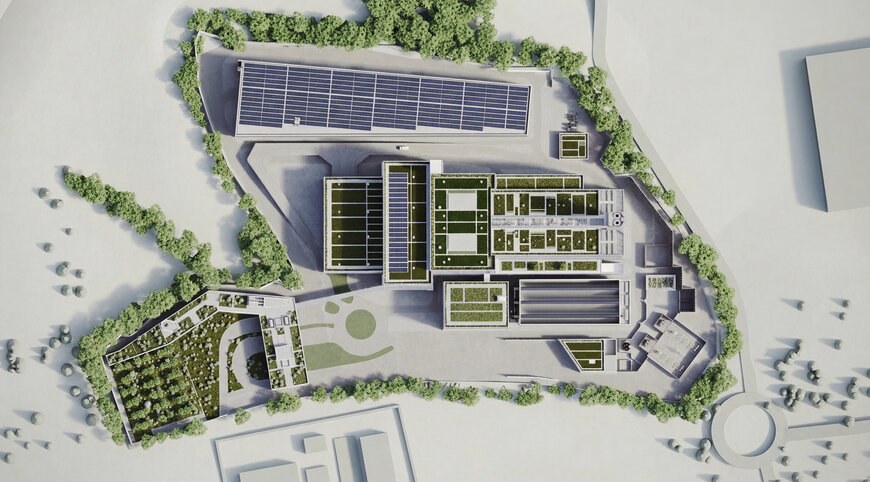
Rome has awarded a concession for a new waste-to-energy (WtE) facility to RenewRome, a project company involving Kanadevia Inova, Acea, Suez, Vianini Lavori and RMB. The plant, located in Santa Palomba southwest of the capital, is designed to process non-recyclable municipal waste currently sent to landfill or exported for treatment elsewhere in Europe. Kanadevia Inova will act as lead Engineering, Procurement and Construction (EPC) contractor and will maintain the facility once operational.
The project combines waste treatment, electricity generation, carbon capture and material recovery technologies intended to support circular economy objectives and reduce landfill dependency.
Waste-to-energy infrastructure designed for municipal waste processing
The two-line facility has been designed to process approximately 600,000 tonnes of municipal solid waste annually while generating around 65 MW of electricity, equivalent to the consumption needs of roughly 200,000 households. Construction began on 14 May, with first waste deliveries scheduled for autumn 2029.
In addition to electricity generation, the plant will include systems for metal recovery, ash collection for reuse in other industries, and carbon dioxide capture and liquefaction. Ancillary circular economy infrastructure will include bottom ash treatment and integration of steam into district heating systems.
Flue gas treatment technology targets European emission standards
The facility incorporates a multi-stage Flue Gas Treatment (FGT) system consisting of a semi-dry treatment unit, wet scrubber, and Selective Catalytic Reduction technology for nitrogen oxide reduction. According to the project details, this configuration is intended to achieve the lowest emission thresholds defined under European directives while applying Best Available Techniques (BAT).
To reduce pressure on local water resources, the plant design includes condensation and reuse of water contained in flue gases for internal operations. This approach supports lower freshwater demand compared with conventional processes requiring continuous external water input.
Integrated circular economy infrastructure beyond energy generation
The project includes development of the “Parco delle Risorse Circolari”, featuring research facilities, co-working areas, an experimental greenhouse, public green spaces and a panoramic tower exceeding 70 metres in height. The concept extends the site beyond waste processing to include research and community functions linked to circular economy activities.
Kanadevia Inova will retain a minority ownership stake in the project company and provide maintenance services under a 30-year concession agreement, reflecting the increasing use of long-term operational models in waste infrastructure projects.
Additional Context
Technical specifications and competitive benchmarking not included in the original product announcement
European waste-to-energy projects developed by operators such as Covanta, EEW Energy from Waste and Kanadevia Inova are commonly benchmarked by annual waste processing capacity, electricity generation efficiency, emissions performance and resource recovery integration. Compared with many conventional WtE facilities focused primarily on electricity generation, the Rome project combines 600,000 tonnes annual treatment capacity with carbon capture, metal recovery, bottom ash processing and district heating applications.
For comparison, the Copenhagen ARC (Amager Bakke) plant processes approximately 560,000 tonnes of waste annually and generates electricity and district heating, while the Rome facility is designed for 600,000 tonnes per year and incorporates carbon dioxide capture infrastructure in addition to multi-stage flue gas treatment. These features reflect increasing competition among European WtE projects to expand circular economy functions beyond waste disposal and power generation.
Edited by Natania Lyngdoh, Induportals editor, assisted by AI.
www.kanadevia-inova.com
