
www.technology4environment.com
23
'26
Written on Modified on
Grid-Connected Battery System for Renewable Integration
Noveria Energy and TenneT Germany collaborate on a 250 MW battery storage project to stabilise grid operations and support renewable energy integration.
www.noveriaenergy.com
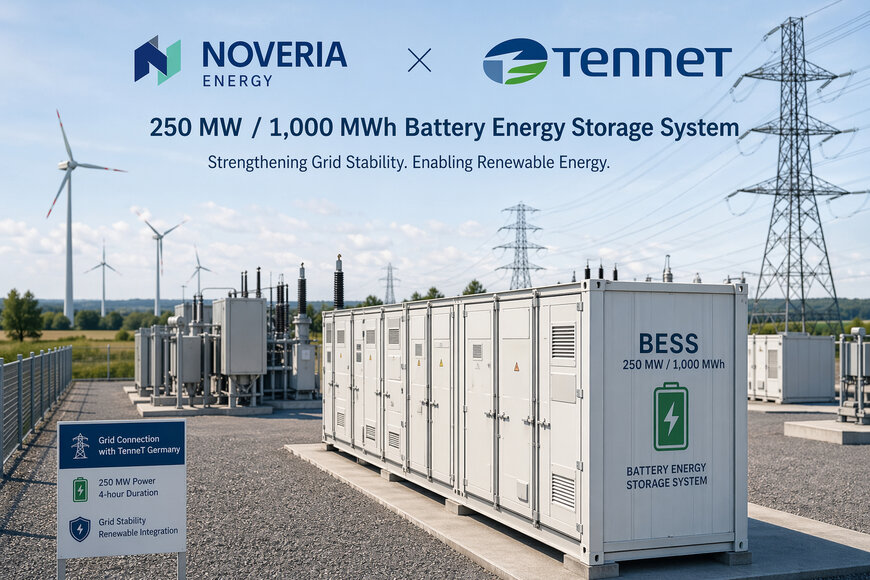
Noveria Energy and TenneT Germany have entered into a grid connection construction agreement to deploy a 250 MW / 1,000 MWh battery energy storage system (BESS) in northwest Germany. The project is designed to improve grid stability and enable higher penetration of renewable energy within the transmission network.
Context of the Cooperation
Noveria Energy, a Germany-based developer of utility-scale battery storage systems and part of Bluestar Energy Capital, is responsible for project development and asset delivery. TenneT Germany, a transmission system operator, manages high-voltage grid infrastructure and ensures system reliability across large parts of the country.
The cooperation addresses operational challenges arising from increasing volumes of intermittent renewable generation, particularly offshore wind power in northern Germany. Variability in generation and transmission constraints require flexible assets capable of balancing supply and demand in real time. The scale and grid-level integration of such systems necessitate coordination between developers and transmission operators.
Technical Solution and Responsibilities
The project consists of a 250 MW battery energy storage system with a discharge duration of four hours, resulting in a total storage capacity of 1,000 MWh. The system is designed to provide grid services such as frequency regulation, load balancing, and congestion management within the transmission network.
Noveria Energy is responsible for system design, permitting, and construction of the BESS infrastructure, including battery modules, power conversion systems, and energy management systems. TenneT Germany oversees grid connection engineering, compliance with transmission standards, and integration into the high-voltage network.
The system will interface with the grid through substations aligned with TenneT’s technical requirements, ensuring compatibility with grid codes and operational protocols. Control systems will enable real-time response to grid conditions, supporting frequency containment and reserve markets.
Deployment and Implementation
The project is located in Niedersachsen, a region with significant offshore wind energy inflows from the North Sea. The grid connection agreement secures a planned connection date in early 2028 and defines the technical and operational framework for integration.
Implementation includes construction of the battery facility, connection infrastructure, and commissioning phases aligned with transmission system requirements. The project will be integrated into existing grid infrastructure to support regional and national power flows.
Applications and Use Cases
The system targets applications in digital infrastructure for energy systems and grid-scale industrial automation of power balancing. Key use cases include:
- Stabilisation of frequency deviations in high-renewable scenarios
- Absorption of excess wind generation during low demand
- Dispatch of stored energy during peak load periods
- Reduction of grid congestion in transmission corridors
Expected Impact
By providing 1,000 MWh of flexible storage capacity, the system enhances the operational resilience of the transmission network. It enables more efficient utilisation of renewable generation by reducing curtailment and improving load matching.
The cooperation establishes a framework for integrating large-scale storage into transmission-level operations, supporting long-term system stability as renewable capacity continues to expand.
Edited by an industrial journalist Sucithra Mani with AI assistance.
www.noveriaenergy.com
By providing 1,000 MWh of flexible storage capacity, the system enhances the operational resilience of the transmission network. It enables more efficient utilisation of renewable generation by reducing curtailment and improving load matching.
The cooperation establishes a framework for integrating large-scale storage into transmission-level operations, supporting long-term system stability as renewable capacity continues to expand.
Edited by an industrial journalist Sucithra Mani with AI assistance.
www.noveriaenergy.com
