
www.technology4environment.com
14
'26
Written on Modified on
Cargill Baupte Modernization Slashes Site Emissions by 45%
Cargill achieved significant decarbonization in France by implementing electric vapor recompression technology, cutting 13,700 tons of annual CO2 while enhancing efficiency for global food ingredient production.
www.cargill.com
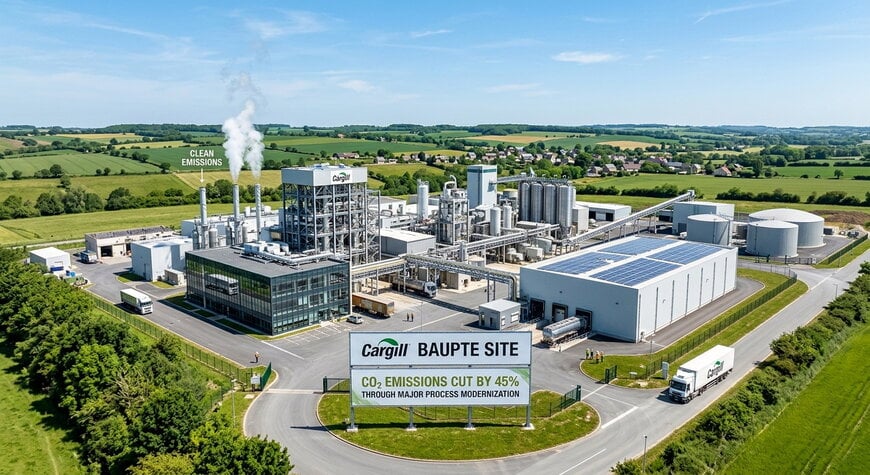
While many industrial manufacturers are still navigating the complexities of the energy transition, Cargill’s Baupte facility has secured a significant competitive advantage through a major technological leap. By modernizing its most energy-intensive processes, the site has achieved a 45% reduction in total CO2 emissions, positioning it as a leader in low-carbon manufacturing for carrageenan and biopolymers. This strategic €25 million investment allows the facility to meet the growing global demand for sustainably produced texturizing solutions — such as those used in dairy alternatives and pharmaceuticals — more efficiently than traditional gas-reliant competitors.
Mechanical Vapor Recompression: The Electrification Advantage
The cornerstone of this transformation is the implementation of Mechanical Vapor Recompression (MVR) technology, which fundamentally changes how the site manages heat. Unlike standard production facilities that rely on natural gas-based steam, the MVR system is electrically driven. It functions by capturing, recompressing, and reusing the vapors generated during the production process as the primary heat source. This circular energy model, which became operational at the end of 2025, allows the site to maintain high production performance while eliminating approximately 13,700 metric tons of CO2 annually.
Scaling Industrial Performance and Sovereignty
The modernization in Baupte serves as a primary example of how electrification can be used as a lever for reindustrialization and increased competitiveness. By shifting toward decarbonized electricity, the facility aligns with broader French and European industrial strategies that prioritize environmental transition without sacrificing industrial sovereignty. This technological shift is a critical component of Cargill’s global objective to reduce operational emissions by 25% by 2035, ensuring the site remains a resilient hub for the 75% of its production that is exported to global markets.
A Global Hub for Food Innovation
Established in 1941 and employing 275 people, the Baupte site does more than manufacture ingredients; it serves as a central pillar for food science through its dairy-focused Food Innovation Center. This center works in tandem with the newly upgraded production lines to help manufacturers reformulate products — ranging from confectionery to plant-based sauces — ensuring they meet modern consumer expectations for texture and stability. By combining cutting-edge MVR technology with specialized application expertise, the facility provides a specialized, low-emission supply chain that distinguishes its output from conventional, higher-emission alternatives.
Edited by Evgeny Churilov, Induportals Media - Adapted by AI.
www.cargill.com
