
www.technology4environment.com
28
'26
Written on Modified on
GHG Emissions Scopes and the Growing Need for Effective Carbon Accounting
An expert perspective on emissions scopes, reporting standards and carbon accounting by Louis Liu, Sustainability Project Engineer, Rehlko.
www.rehlko.com
As organisations worldwide intensify efforts to measure and reduce greenhouse gas (GHG) emissions, carbon accounting has become a critical discipline for ensuring accuracy, consistency, and transparency. With more countries and businesses now reporting emissions data, the importance of harmonised metrics and robust data collection methods has never been greater.
To support this, a number of internationally recognised standards have emerged. Among the most influential is the Science Based Targets initiative (SBTi), developed in collaboration with CDP, the UN Global Compact, the World Resources Institute (WRI), and WWF. SBTi provides a science-based framework for setting emissions reduction targets aligned with climate goals. By the end of 2021, more than 2,250 companies across 70 countries had adopted SBTi-approved targets.
Another cornerstone of carbon accounting is the GHG Protocol, developed by WRI and the World Business Council for Sustainable Development (WBCSD). It is the most widely used global standard for measuring and managing emissions, adopted across public and private sectors. More than 90% of Fortune 500 companies report emissions using the GHG Protocol framework.
Evolving climate regulations and disclosure requirements
Regulatory pressure is accelerating worldwide. All parties to the UN Framework Convention on Climate Change (UNFCCC) are required to report national GHG emissions annually, and many jurisdictions now mandate corporate environmental reporting and reduction strategies.
The CDP plays a key role in this ecosystem by supporting environmental disclosure. In 2020 alone, over 9,600 organisations—responsible for roughly 20% of global GHG emissions—reported through CDP, creating the world’s most comprehensive environmental data repository.
In Europe, regulatory expectations have expanded significantly with the introduction of the Corporate Sustainability Reporting Directive (CSRD). Initially covering approximately 11,700 organisations, the directive requires companies to report environmental and social performance in line with European Sustainability Reporting Standards (ESRS). However, in February 2025, the EU announced revisions under the Omnibus Sustainability package to reduce regulatory burden. The revised CSRD now applies only to organisations with more than 1,000 employees and either turnover above €50 million or a balance sheet exceeding €25 million—reducing the number of in-scope companies by around 80%. Importantly, the timeline for implementation has been extended, with transposition now required by July 2026.
Globally, the International Sustainability Standards Board (ISSB) introduced IFRS S1 and IFRS S2 in 2023, establishing a common language for climate-related financial disclosures. These standards have received strong backing from investors, regulators, and international bodies including the G20 and G7.
Understanding emissions scopes
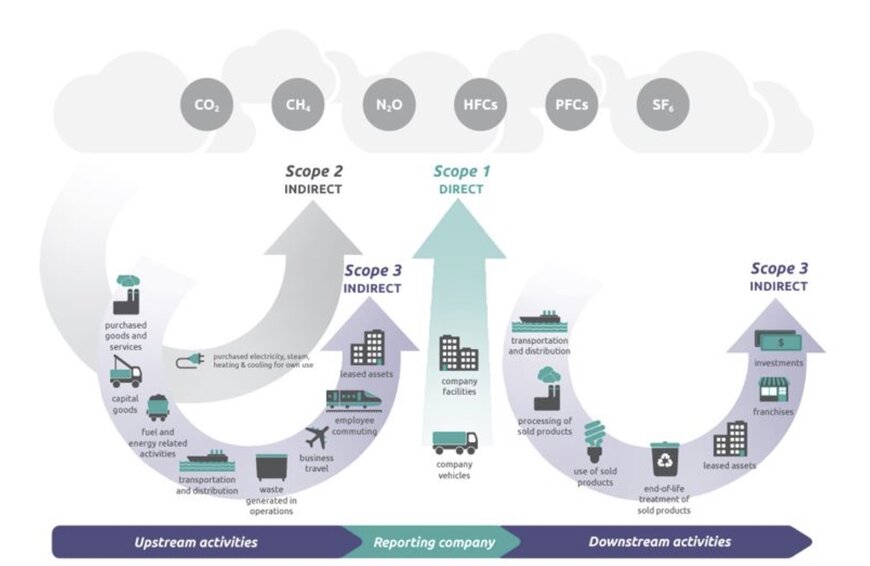
Under the GHG Protocol, emissions are categorised into three scopes:
- Scope 1 emissions are direct emissions generated by an organisation’s own operations. For a generator manufacturer such as Rehlko, this includes emissions from production processes, testing activities, and company-owned vehicles.
- Scope 2 emissions are indirect emissions from purchased energy, such as electricity or gas used to power operations. While generated off-site, these emissions remain under a company’s influence through energy efficiency initiatives or renewable energy sourcing.
- Scope 3 emissions encompass all other indirect emissions across the value chain, both upstream and downstream. These include emissions from raw material extraction, supplier manufacturing, logistics, business travel, employee commuting, product use, and end-of-life disposal.
While Scope 1 and 2 emissions are largely within an organisation’s direct control, Scope 3 emissions often represent the largest share of total emissions—and the most complex to measure.
Why Scope 3 accounting matters
Accounting for Scope 3 emissions provides a complete picture of an organisation’s environmental impact. It helps identify emission hotspots across the value chain, uncover cost-saving opportunities, and drive collaboration with suppliers and customers. However, the challenge is significant: fewer than 30% of companies globally disclose meaningful Scope 3 data, and many limit reporting to business travel and commuting.
Some European organisations are leading by example. Companies such as L’Oréal, Unilever, IKEA, AstraZeneca, Michelin, and Saint-Gobain have embedded Scope 3 targets into their sustainability strategies. L’Oréal, for instance, has set targets covering net-zero Scope 1 and 2 emissions, reductions in cradle-to-shelf emissions, and increased use of recycled or bio-based packaging.
At Rehlko, downstream product use represents a substantial portion of Scope 3 emissions. When customers operate diesel generators, those emissions contribute to both the customer’s Scope 1 and Rehlko’s Scope 3 footprint. To address this, Rehlko has introduced initiatives such as Conscious Care, which reduces genset testing duration and frequency, and certification of systems for alternative fuels like hydrotreated vegetable oil (HVO). These measures reduce emissions across both customer operations and the wider value chain.
Accuracy must go hand-in-hand with action
As carbon accounting frameworks evolve, transparency is improving—but measurement alone is not enough. While accurate Scope 3 accounting is essential, it must not delay or overshadow the urgent need for emissions reduction. Robust accounting and aggressive decarbonisation strategies must progress in parallel.
Rehlko remains committed to collaborating with customers and partners to identify practical, impactful pathways to reduce emissions—ensuring businesses can operate reliably while minimising environmental impact.
www.rehlko.com
Why Scope 3 accounting matters
Accounting for Scope 3 emissions provides a complete picture of an organisation’s environmental impact. It helps identify emission hotspots across the value chain, uncover cost-saving opportunities, and drive collaboration with suppliers and customers. However, the challenge is significant: fewer than 30% of companies globally disclose meaningful Scope 3 data, and many limit reporting to business travel and commuting.
Some European organisations are leading by example. Companies such as L’Oréal, Unilever, IKEA, AstraZeneca, Michelin, and Saint-Gobain have embedded Scope 3 targets into their sustainability strategies. L’Oréal, for instance, has set targets covering net-zero Scope 1 and 2 emissions, reductions in cradle-to-shelf emissions, and increased use of recycled or bio-based packaging.
At Rehlko, downstream product use represents a substantial portion of Scope 3 emissions. When customers operate diesel generators, those emissions contribute to both the customer’s Scope 1 and Rehlko’s Scope 3 footprint. To address this, Rehlko has introduced initiatives such as Conscious Care, which reduces genset testing duration and frequency, and certification of systems for alternative fuels like hydrotreated vegetable oil (HVO). These measures reduce emissions across both customer operations and the wider value chain.
Accuracy must go hand-in-hand with action
As carbon accounting frameworks evolve, transparency is improving—but measurement alone is not enough. While accurate Scope 3 accounting is essential, it must not delay or overshadow the urgent need for emissions reduction. Robust accounting and aggressive decarbonisation strategies must progress in parallel.
Rehlko remains committed to collaborating with customers and partners to identify practical, impactful pathways to reduce emissions—ensuring businesses can operate reliably while minimising environmental impact.
www.rehlko.com
