

www.technology4environment.com
10
'26
Written on
Modified on
bound4blue News
Suction sails expand wind-assisted propulsion channels for larger merchant vessels
DNV awards type approval to bound4blue aerodynamic technology to accelerate maritime decarbonization.
bound4blue.com
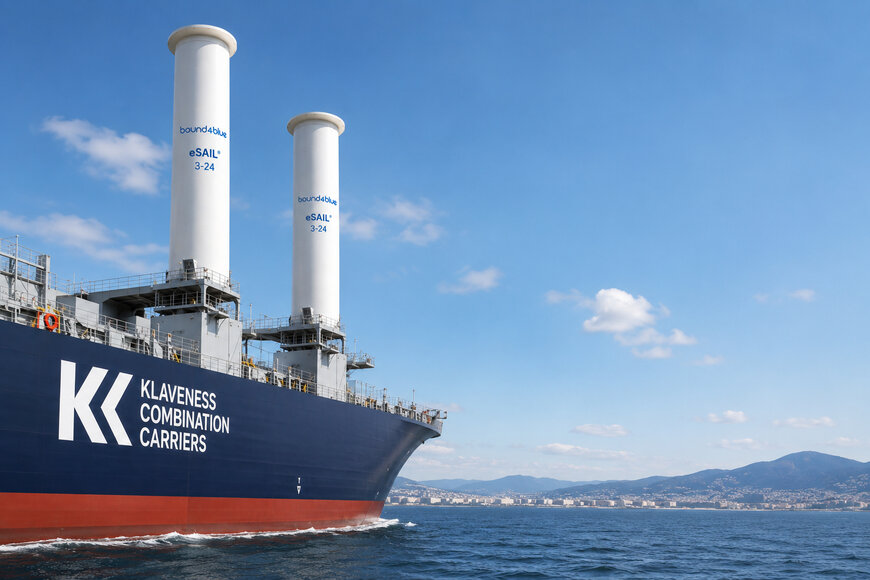
The regulatory classification society DNV has issued a Type Approval Design Certificate for the Model 3-24 eSAIL developed by bound4blue. This independent certification validates the structural integrity, safety mechanisms, and design robustness of the wind-assisted propulsion technology under realistic marine environments.
Boundary layer suction aerodynamics and chord geometry
The wind-assisted propulsion system relies on boundary layer suction technology to optimize aerodynamic efficiency. The mechanical structure consists of a rigid vertical cylinder equipped with an internal suction fan. This fan draws air through a series of porous openings along the suction surface, suppressing the boundary layer separation that naturally occurs on non-rotating aerodynamic bodies.
By manipulating the flow field, the system generates a localized high-lift coefficient with a wider chord layout and expanded surface area compared to earlier platform configurations. The structural envelope of the Model 3 range spans heights from 24 meters to 36 meters to provide propulsion support for deep-sea merchant vessels. Two initial units were installed on the newbuild combination carrier vessel MV Baltazar to deliver propulsive force directly to the ship hull, reducing main engine loads and primary fuel consumption.
Maritime regulatory compliance frameworks and integration criteria
The autonomous system adapts to changing apparent wind angles via real-time sensory tracking without requiring manual operator intervention or complex mechanical tilting mechanisms. The resulting reduction in fuel burn assists vessel operators in satisfying international maritime regulatory frameworks, including Carbon Intensity Indicator metrics and Energy Efficiency Existing Ship Index requirements.
Furthermore, the verified reduction in carbon dioxide emissions lowers economic exposure within market-based frameworks such as the FuelEU Maritime regulation and the EU Emissions Trading System. The plug-and-play architectural interface allows these rigid sail assemblies to be integrated into existing deck structures during retrofits or integrated directly during the initial construction phases of bulkers, tankers, and general cargo hulls.
Additional Context: This section details technical specifications and competitive benchmarking not included in the original product announcement
Within the wind-assisted propulsion system market, suction sails compete directly with alternative wind technologies, including rotor sails and rigid wing sails. Objective benchmarking reveals that suction sails like the bound4blue eSAIL provide an exceptionally high lift-to-space ratio, allowing compact deck footprints compared to massive rigid wing variants that require complex folding or tilting mechanisms to manage air draft restrictions in ports.
Furthermore, while spinning rotors require continuous electrical power inputs to drive the Magnus effect, the boundary layer suction fan within the eSAIL uses less auxiliary power relative to total lift generated under specific apparent wind angles. However, rigid wing designs typically maintain higher aerodynamic efficiency when sailing close to the wind, up to 45 degrees apparent wind angle, whereas suction sails demonstrate optimal lift coefficients during reaching and running conditions. Currently, the structural parameters of the Model 3-24 limit its deployment to larger vessel classes, as the high aerodynamic overturning moments require reinforced deck structures that are not readily compatible with small general cargo hulls.
Edited by Sucithra Mani, Induportals editor – adapted by AI.
www.bound4blue.com
